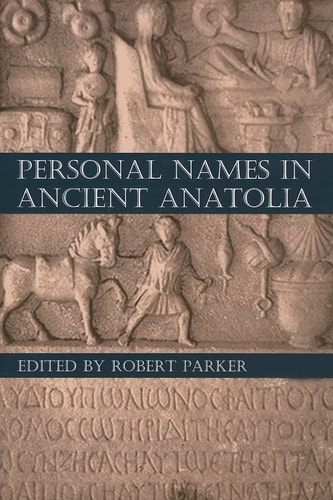
Personal Names in Ancient Anatolia
0
0
As an Amazon Associate and affiliate partner, Menrva Books earns from qualifying purchases. Learn more
Author Description
Ancient Anatolia was a region where many indigenous or at least long-established peoples mingled with many conquerors or incomers: Persians, Greeks, Gauls, Romans, Jews. Its rich and complex history of cultural interaction is only spasmodically illuminated by literary sources. Inscriptions, by contrast, abound and attest well over 100,000 name-bearing inhabitants. Many of those names retain regional associations, and when analysed with tact allow lost histories and micro-histories to be recovered.This volume exploits the huge possibilities for social and linguistic history being created by the expansion of The Lexicon of Greek Personal Names into Anatolia. One topic is that of continuities and discontinuities between the naming practices of the Hittites and Luvians in the second millennium BC and those of the Greco-Roman period. Several studies trace changing patterns of naming in particular regions; this may reflect real changes in population, but the need for sociological sensitivity is stressed, as the change may lie rather in changing self-perceptions or preferred self-identifications.The Anatolian treasure house of names can also be used to illuminate the psychology of naming, the rise of nursery nicknames to the status of proper names (and their subsequent fall from favour), for instance, or the fascination with exotic luxury items expressed in names such as Amethyst or Emerald, or the fashion for 'second names' among the Greek-speaking elite. The volume shows how, as has been said, the study of names is a 'paradigm case of the convergence of disciplines, where the history of language meets social history'.
Menrva's Summary
THE THESIS
This volume investigates how the analysis of personal names in ancient Anatolia serves as a critical tool for reconstructing the social, linguistic, and cultural histories of a region defined by intense interaction between indigenous populations and successive waves of conquerors. Robert Dale Parker and contributing scholars utilize the expansive data provided by the Lexicon of Greek Personal Names to bridge the gap between sparse literary records and the abundant epigraphic evidence found in inscriptions. The work argues that naming practices are not merely static identifiers but dynamic reflections of shifting self-perceptions, population movements, and evolving sociological identities across the second millennium BC through the Greco-Roman period.
THE SCOPE MAP
What You Will Find
- Comparative analysis of naming conventions from the Hittite and Luvian periods through the Greco-Roman era.
- Methodological frameworks for interpreting name changes as indicators of either demographic shifts or cultural assimilation.
- Examination of the psychology of naming, including the transition of nicknames into formal nomenclature and the influence of luxury goods on naming fashions.
- Integration of linguistic data with social history to map the cultural convergence of Persians, Greeks, Gauls, Romans, and Jews within Anatolia.
THE AUTHORITY PERSPECTIVE
Experts recognize this volume as a significant contribution to the field of onomastics and the broader study of ancient Mediterranean social structures. Scholars frequently highlight the text for its rigorous interdisciplinary approach, noting that it provides a foundational methodology for researchers attempting to extract historical meaning from large-scale epigraphic datasets.
Page Count:
230
Publication Date:
2014-01-28
Publisher:
British Academy
ISBN-10:
0197265634
ISBN-13:
9780197265635
History
Linguistics
Social History
Ancient History
Names Personal
Onomastics
Community Tags
Similar Books