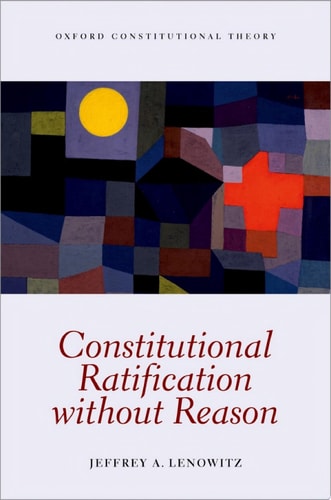
Constitutional Ratification without Reason
0
0
As an Amazon Associate and affiliate partner, Menrva Books earns from qualifying purchases. Learn more
Author Description
This volume focuses on constitutional ratification, the procedure in which a draft constitution is submitted by its creators to the people or their representatives in an up or down vote determining implementation. Ratification is increasingly common and routinely recommended by experts. Nonetheless, it is neither neutral nor inevitable. Constitutions can be made without it and when it is used it has significant effects. This raises the central question of the book: should ratification be recommended? Put another way: is there a reason for treating the procedure as a default for the constitution-making process? Surprisingly, these questions are rarely asked. The procedure's worth is assumed, not demonstrated, while ratification is generally overlooked in the literature. In fact, this is the first sustained study of ratification. To address these oversights, this book defines ratification and its types, explains the procedure's effects, conceptual origins, and history, and then concentrates on finding reasons for its use. Specifically, it builds up and analyzes the three most likely normative justifications. These urge the implementation of ratification because the procedure: enables the constituent power to make its constitution; fosters representation during constitution-making; or helps create a legitimate constitution. Ultimately, these justifications are found wanting, leading to the conclusion that ratification lacks a convincing, context-independent justification. Thus, until new arguments are developed, experts should not give recommendations for ratification as a matter of course, practitioners should not reach for it uncritically, and-more generally-one should avoid the blanket application of concepts from democratic theory to extraordinary contexts such as constitution-making.
Menrva's Summary
THE THESIS
This book investigates whether constitutional ratification possesses a sound normative justification to be recommended as a default procedure in constitution-making. Jeffrey A. Lenowitz, a scholar of political theory and constitutional design, evaluates the common assumption that ratification is a necessary or inherently beneficial step in the creation of new constitutions. By analyzing the historical and conceptual origins of the practice, the author challenges the prevailing consensus among experts and practitioners who treat ratification as an unexamined standard.
THE SCOPE MAP
What You Will Find
- A comprehensive definition and typology of constitutional ratification procedures.
- An analysis of three primary normative justifications: constituent power, representation, and legitimacy.
- A historical overview of constitution-making processes that occurred with and without formal ratification.
Scope Limits
- The text does not provide a prescriptive manual for how to draft a constitution in the absence of ratification.
- It does not focus on the specific legal mechanics of individual national constitutions, but rather on the theoretical framework of the ratification process itself.
THE AUTHORITY PERSPECTIVE
Scholars in the field of constitutional design recognize this work as a significant intervention that forces a re-evaluation of standard democratic practices in extraordinary political contexts. The text is noted for its rigorous analytical approach and its success in identifying a major gap in existing political science literature.
Page Count:
436
Publication Date:
2022-01-01
Publisher:
OUP Oxford
ISBN-10:
019259348X
ISBN-13:
9780192593481
Constitutional Law
Professional Career & Trade
Political Philosophy
Legal History
Democratic Theory