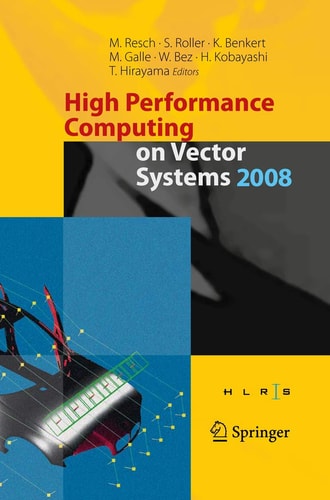
High Performance Computing on Vector Systems 2008
0
0
As an Amazon Associate and affiliate partner, Menrva Books earns from qualifying purchases. Learn more
Author Description
This book covers the results obtained in the Tera op Workbench project during a four years period from 2004 to 2008. The Tera op Workbench project is a colla- ration betweenthe High PerformanceComputingCenter Stuttgart (HLRS) and NEC Deutschland GmbH (NEC-HPCE) to support users to achieve their research goals using high performance computing. The Tera op Workbench supports users of the HLRS systems to enable and - cilitate leading edge scienti c research. This is achieved by optimizing their codes and improving the process work ow which results from the integration of diff- ent modules into a “hybrid vector system”. The assessment and demonstration of industrial relevance is another goal of the cooperation. The Tera op Workbench project consists of numerous individual codes, grouped together by application area and developed and maintained by researchers or c- mercial organizations. Within the project, several of the codes have shown the ab- ity to reach beyond the TFlop/s threshold of sustained performance. This created the possibility for new science and a deeper understanding of the underlying physics. The papers in this book demonstrate the value of the project for different scienti c areas.
Menrva's Summary
THE THESIS
This book details the advancements and findings from the Tera op Workbench project, a four-year collaboration focused on optimizing high-performance computing on vector systems. The project, a partnership between the High Performance Computing Center Stuttgart (HLRS) and NEC Deutschland GmbH, aimed to support researchers in achieving their scientific goals through advanced computing. It facilitated leading-edge research by optimizing codes and improving workflow integration within a hybrid vector system, with a focus on demonstrating industrial relevance. Several codes developed within the project achieved sustained performance beyond the TFlop/s threshold, opening new avenues for scientific discovery and deeper physical understanding.
THE SCOPE MAP
- Results from the Tera op Workbench project (2004-2008).
- Details on code optimization and workflow improvements for high-performance computing.
- Assessment and demonstration of industrial relevance in scientific research.
- Case studies of codes achieving sustained performance beyond the TFlop/s threshold.
- Demonstrations of the project's value across various scientific areas.
THE AUTHORITY PERSPECTIVE
This compilation presents the outcomes of a significant research collaboration focused on high-performance computing. The papers within demonstrate the practical application and success of the Tera op Workbench project in advancing scientific research through optimized vector systems. The work highlights the achievement of substantial computational milestones, such as exceeding the TFlop/s threshold, underscoring the project's contribution to scientific understanding and industrial relevance.
Page Count:
242
Publication Date:
2008-11-04
Publisher:
Springer Berlin Heidelberg
ISBN-10:
3540858687
ISBN-13:
9783540858683
Science
Science & Technology
Non-Fiction
Technology
Computer Science
Community Tags
Other Editions(2)
Similar Books