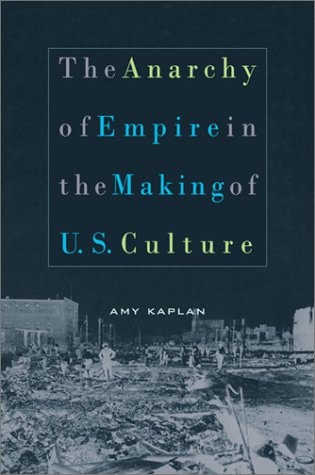
The Anarchy of Empire in the Making of U.S. Culture
0
0
As an Amazon Associate and affiliate partner, Menrva Books earns from qualifying purchases. Learn more
Author Description
The United States has always imagined that its identity as a nation is insulated from violent interventions abroad, as if a line between domestic and foreign affairs could be neatly drawn. Yet this book argues that such a distinction, so obviously impracticable in our own global era, has been illusory at least since the war with Mexico in the mid-nineteenth century and the later wars against Spain, Cuba, and the Philippines. In this book, Amy Kaplan shows how U.S. imperialism--from "Manifest Destiny" to the "American Century"--has profoundly shaped key elements of American culture at home, and how the struggle for power over foreign peoples and places has disrupted the quest for domestic order. The neatly ordered kitchen in Catherine Beecher's household manual may seem remote from the battlefields of Mexico in 1846, just as Mark Twain's Mississippi may seem distant from Honolulu in 1866, or W. E. B. Du Bois's reports of the East St. Louis Race Riot from the colonization of Africa in 1917. But, as this book reveals, such apparently disparate locations are cast into jarring proximity by imperial expansion. In literature, journalism, film, political speeches, and legal documents, Kaplan traces the undeniable connections between American efforts to quell anarchy abroad and the eruption of such anarchy at the heart of the empire.
Menrva's Summary
THE THESIS
This book investigates the profound and often overlooked impact of U.S. imperialism on American domestic culture. Amy Kaplan argues that the United States has historically maintained an illusory distinction between its foreign interventions and its internal affairs, a separation that has been untenable since the mid-nineteenth century. Through an examination of literature, journalism, film, political speeches, and legal documents, Kaplan demonstrates how imperial expansion has shaped key elements of American culture and disrupted the pursuit of domestic order, revealing jarring proximities between foreign battlefields and the heart of the empire.
THE SCOPE MAP
- Analysis of the U.S. war with Mexico and subsequent wars against Spain, Cuba, and the Philippines as foundational to U.S. identity.
- Exploration of how concepts like 'Manifest Destiny' and the 'American Century' are intertwined with imperial actions.
- Examination of literary works by authors such as Mark Twain and W. E. B. Du Bois in relation to imperial contexts.
- Discussion of domestic cultural artifacts, like Catherine Beecher's household manual, as reflecting or reacting to imperial anxieties.
- Tracing connections between U.S. efforts to quell 'anarchy abroad' and the emergence of disorder within the nation.
- Use of primary source materials including political speeches and legal documents.
- Focus on the disruption of domestic order as a consequence of imperial power struggles.
THE AUTHORITY PERSPECTIVE
Amy Kaplan's work is recognized for its rigorous analysis of the interconnectedness between American foreign policy and its cultural output. The book is noted for its detailed examination of how imperial ambitions have shaped national identity and domestic life, drawing on a wide array of cultural and historical sources. Scholars have pointed to its insightful critique of the perceived separation between domestic and foreign affairs, highlighting its relevance to understanding contemporary U.S. culture. The book's argument regarding the disruption of domestic order by imperial expansion has been a significant contribution to the fields of American Studies and cultural history.
Page Count:
272
Publication Date:
2003-02-17
Publisher:
Harvard University Press
ISBN-10:
0674009134
ISBN-13:
9780674009134
History
Non-Fiction
Literary Criticism
American Studies
Community Tags
Similar Books