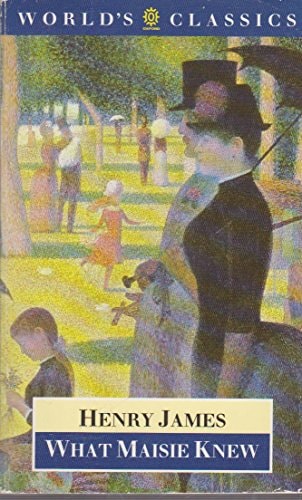
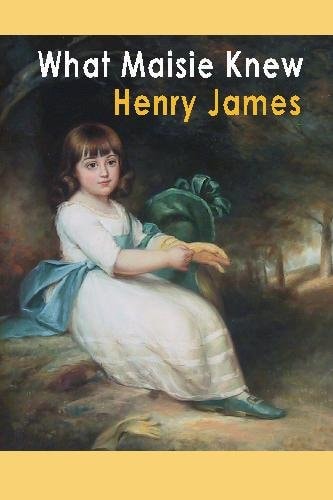
What Maisie Knew
0
0
As an Amazon Associate and affiliate partner, Menrva Books earns from qualifying purchases. Learn more
Author Description
Show Excerpt, the paper was thrust away in her pocket and there clenched in her fist. The supreme hour was to furnish her with a vivid reminiscence, that of a strange outbreak in the drawing- room on the part of Moddle, who, in reply to something her father had just said, cried aloud: "You ought to be perfectly ashamed of yourself--you ought to blush, sir, for the way you go on!" The carriage, with her mother in it, was at the door; a gentleman who was there, who was always there, laughed out very loud; her father, who had her in his arms, said to Moddle: "My dear woman, I'll settle you presently!"--after which he repeated, showing his teeth more than ever at Maisie while he hugged her, the words for which her nurse had taken him up. Maisie was not at the moment so fully conscious of them as of the wonder of Moddle's sudden disrespect and crimson face; but she was able to produce them in the course of five minutes when, in the carriage, her mother, all kisses, ribbons, eyes, arms, strange sounds and sweet smells, said to
Menrva's Summary
THE PULSE
A young girl named Maisie Farange navigates the volatile fallout of her parents' bitter divorce while being passed between them like a pawn. Maisie attempts to maintain a sense of stability as she observes the moral failings and manipulative behaviors of the adults surrounding her. The narrative framework utilizes a third-person limited perspective that focuses intensely on Maisie's developing consciousness, forcing the reader to interpret adult complexities through the eyes of a child. She faces the logical constraint of her own youth, which prevents her from fully comprehending the sexual and social impropriety of her guardians, yet she remains the only character capable of genuine perception.
INSIDE THE PAGES
- Third-person limited point of view centered on a child protagonist
- Exploration of moral ambiguity in Victorian society
- Satirical portrayal of parental neglect and selfishness
- Complex, dense prose style characteristic of late-period James
- Focus on the psychological development of a child in a fractured home
- Use of irony to highlight the ignorance of the adult characters
- Examination of the role of governesses and stepparents
- Gradual shift from passive observation to active moral agency
THE COLLECTIVE ECHO
Discussion often centers on the technical mastery Henry James displays in maintaining a child's perspective while layering the narrative with adult subtext. Readers frequently highlight the uncomfortable nature of the adult characters, whose self-absorption stands in stark contrast to Maisie's quiet, observant nature. Critics often analyze the book as a study in the loss of innocence, noting how the protagonist's environment forces her to mature at an accelerated rate. The pacing is deliberate and internal, favoring psychological depth over external plot progression, which requires patience from the reader to fully appreciate the subtle shifts in Maisie's understanding of her world.
Page Count:
304
Publication Date:
1981-05-21
Publisher:
Oxford University Press
ISBN-10:
0192815334
ISBN-13:
9780192815330
Literary Fiction
Psychological
Victorian
Coming of Age
classic
Community Tags
Other Editions(31)
Alpha Edition
2025
Default edition
Hansebooks GmbH
2023

Independently Published
2021

Independently Published
2021

Independently Published
2021

Independently Published
2020
Independently Published
2020
Independently Published
2020

Independently Published
2020

Independently Published
2020

Independently Published
2020
Astral International Pvt. Limited
2019

Naxos and Blackstone Audio
2019

Independently Published
2018
CreateSpace Independent Publishing Platform
2017

Lindhardt og Ringhof
2017

CreateSpace Independent Publishing Platform
2016

Barnes & Noble Press
2016

CreateSpace Independent Publishing Platform
2015

Editorium
2014

Reprint Services Corporation
2013

Max Bollinger
2013

Bollinger, Max
2013
Oxford University Press
2009
CreateSpace Independent Publishing Platform
2009

IndyPublish.com
2006

ReadHowYouWant.com, Limited
2006

North Books
2001

Reprint Services Corporation
1993

Sterling Audio
1991
Oxford University Press
1981
Similar Books


Reader Comments
Share Your Thoughts
No comments yet. Be the first to share your thoughts!