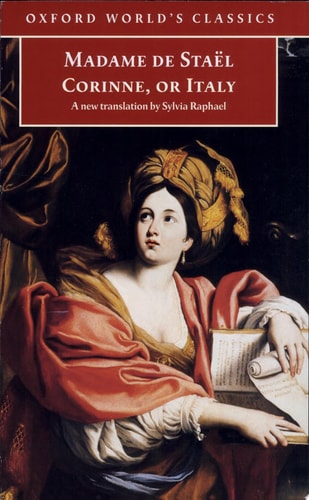
Corinne, or Italy
0
0
As an Amazon Associate and affiliate partner, Menrva Books earns from qualifying purchases. Learn more
Author Description
Corrine, or Italy, is both the story of a love affair between Oswald, Lord Nelvil, and a beautiful poetess, and an homage to the landscape, literature and art of Italy. Stael, the subject of recent feminist rediscovery, weaves discreet political allusion into her romance, and upon its publication Napoleon renewed her order of exile. Sylvia Raphel's new translation preserves the natural character of the French original, while the notes and introduction place this extraordinary work of European Romanticism in its historical and political context.
Menrva's Summary
THE PULSE
The narrative centers on the complex romantic entanglement between the English nobleman Oswald, Lord Nelvil, and the celebrated Italian poetess Corinne, set against the backdrop of a changing Europe. Oswald finds himself torn between his duty to his late father's expectations and his profound attraction to Corinne, a woman who embodies the artistic and intellectual spirit of Italy. As their relationship unfolds, the protagonists navigate the rigid social constraints of their respective cultures and the personal secrets that threaten their union. The narrative employs a blend of travelogue and epistolary elements to examine the tension between individual desire and societal obligation. The story explores the logical constraints of national identity and the personal cost of defying established conventions.
INSIDE THE PAGES
- Exploration of the cultural dichotomy between England and Italy
- Integration of art, architecture, and literature as narrative devices
- Examination of the role of women in public and private spheres
- Use of political allegory to critique contemporary governance
- Detailed descriptions of Italian landscapes and historical sites
- Focus on the conflict between duty and personal passion
- Philosophical reflections on the nature of genius and fame
- Stylistic influence of the European Romantic movement
THE COLLECTIVE ECHO
Discussion often centers on the novel's dual function as a romantic narrative and a sophisticated cultural critique. Readers frequently highlight the author's ability to balance intimate character development with expansive descriptions of the Italian landscape. Critics often note that the work serves as a significant document of early nineteenth-century intellectual life and the challenges faced by women in the public eye. The pacing is described as deliberate, allowing for deep thematic exploration of national identity and personal freedom. Scholars continue to analyze the text for its political subtext and its role in shaping the Romantic literary tradition.
Page Count:
464
Publication Date:
1999-01-07
Publisher:
Oxford University Press
ISBN-10:
0192825054
ISBN-13:
9780192825056
Romance
Historical
European
classic
Romanticism
Travelogue
Community Tags
Similar Books