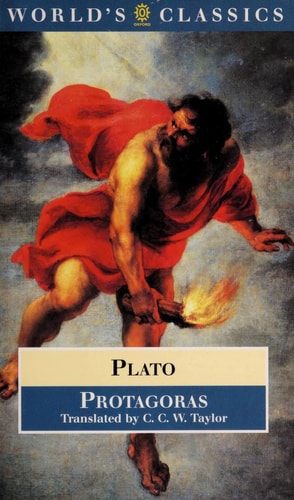
Protagoras
0
0
As an Amazon Associate and affiliate partner, Menrva Books earns from qualifying purchases. Learn more
Author Description
In the fifth century B.C. professional educators, or sophists, travelled the Greek world claiming to teach success in public and private life. In this dialogue Plato shows the pretensions of the leading sophist, Protagoras, challenged by the critical arguments of Socrates. The dialogue combines subtlety of argument with intricacy of dramatic construction and brilliant characterization. This translation achieves both precision and colloquial naturalness, while the Notes and Introduction set the arguments in their historical and philosophical context.
Menrva's Summary
THE THESIS
This dialogue investigates the nature of virtue and whether it can be taught, specifically challenging the claims of the sophists in ancient Greece. Plato, a foundational figure in Western philosophy, utilizes the character of Socrates to interrogate Protagoras, a prominent sophist who asserts that he can instruct individuals in the arts of political and personal success. The text serves as a critical examination of the distinction between professional rhetoric and genuine philosophical wisdom within the context of Athenian society.
THE SCOPE MAP
What You Will Find
- A detailed examination of the Socratic method of dialectical inquiry.
- Historical context regarding the role of sophists in the fifth century B.C.
- Arguments concerning the unity of virtue and the relationship between knowledge and action.
Scope Limits
- The text does not provide a definitive, modern scientific consensus on the nature of moral education.
- It focuses primarily on the specific philosophical concerns of the classical Athenian period rather than contemporary pedagogical theory.
THE AUTHORITY PERSPECTIVE
Scholars and philosophers frequently cite this work as a primary source for understanding the tension between traditional Socratic inquiry and the professionalized instruction offered by the sophists. Readers often note the accessibility of the dialogue's dramatic structure while acknowledging the underlying complexity of the logical arguments presented.
Page Count:
128
Publication Date:
1996-12-19
Publisher:
Oxford University Press
ISBN-10:
0192823302
ISBN-13:
9780192823304
Philosophy
Ethics
Dialogue
Classical
Ancient Greek
Education
Community Tags
Other Editions(67)
Independently published
2024
Default edition
Natal Publishing, Llc
2024
Binker North
2023
Independently published
2023
Independently published
2023
Independently published
2023
Independently published
2023

Blurb
2022

Digireads.com Publishing
2021

Independently Published
2021
Independently Published
2020
Independently Published
2020

Amazon Digital Services LLC - KDP Print US
2020

Independently Published
2020

Brian Westland
2020

Independently Published
2020

Independently Published
2020

Independently Published
2019
Independently Published
2019
Independently Published
2019
Independently Published
2019
Blurb, Incorporated
2019
Amazon Digital Services LLC - KDP Print US
2019
Independently Published
2019

Amazon Digital Services LLC - KDP Print US
2019
Blurb, Incorporated
2019

Amazon Digital Services LLC - KDP Print US
2018

Independently Published
2018
CreateSpace Independent Publishing Platform
2018

Wildside Press LLC
2018

CreateSpace Independent Publishing Platform
2018

Independently Published
2018
CreateSpace Independent Publishing Platform
2017
CreateSpace Independent Publishing Platform
2017
CreateSpace Independent Publishing Platform
2016
CreateSpace Independent Publishing Platform
2016

CreateSpace Independent Publishing Platform
2016

CreateSpace Independent Publishing Platform
2015

CreateSpace Independent Publishing Platform
2015

CreateSpace Independent Publishing Platform
2015

CreateSpace Independent Publishing Platform
2013
CreateSpace Independent Publishing Platform
2013

CreateSpace Independent Publishing Platform
2013

CreateSpace Independent Publishing Platform
2010
Kessinger Publishing, LLC
2010
Kessinger Publishing, LLC
2010
Akasha Classics
2009
Arc Manor
2009
Standard Publications, Incorporated
2008

Artemis & Winkler
2008
Dodo Press
2007

Penguin Books
2006
Digireads.com
2006

ReadHowYouWant.com
2006

ReadHowYouWant.com, Limited
2006

Kessinger Publishing
2004

Quiet Vision Publishing
2004
IndyPublish.com
2003
Oxford University Press
2002
IndyPublish.com
2002

Flammarion
1997
Oxford University Press
1996
Oxford University Press
1992
Clarendon Press
1992

Reclam
1987
Clarendon Press
1976

Project Gutenberg
1900
Similar Books

Reader Comments
Share Your Thoughts
No comments yet. Be the first to share your thoughts!