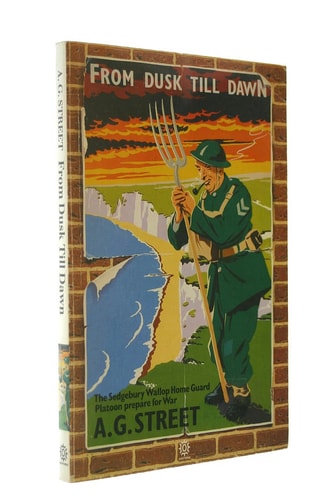
From Dusk Till Dawn: The Sedgebury Wallop Home Guard Platoon Prepare for War
0
0
As an Amazon Associate and affiliate partner, Menrva Books earns from qualifying purchases. Learn more
Author Description
In this book A.G.Street has put on record the story of the Home Guard from its birth in 1940, through its teething troubles and adolescence, to the mature and efficient force that it quickly became. As a farmer and an enthusiastic country Home Guard, he tells the story of the Sedgbury Wallop Platoon in the Wessex district. It was men such as Walter Pocock, "Shep" Yates, Tom Butler and Sir Robert Enfield, who first made the Home Guard into cohesive defence units. The force itself was an example of British improvization, and every one of those early volunteers - officers and men - improvized in a thousand ways to give his unit the highest possible efficiency in the shortest possible time, for in 1940 an invasion was genreally expected. A.G.Street also wrote "Farmer's Glory", "Strawberry Roan", "Hedge Trimmings", "Country Days" and "Ditchampton Farm".
Menrva's Summary
THE THESIS
This book investigates the rapid formation, organizational evolution, and operational development of the British Home Guard during the early years of World War II. A. G. Street, a farmer and active participant in the Home Guard, utilizes his firsthand experience to document the transition of local volunteer units from disorganized groups into effective defense forces. By focusing on the Sedgebury Wallop Platoon in the Wessex district, the author illustrates the broader national trend of improvisation and civic duty that defined the defense of the British Isles against the threat of invasion in 1940.
THE SCOPE MAP
What You Will Find
- A detailed account of the Home Guard's formation starting in 1940
- Case studies of the Sedgebury Wallop Platoon's operational challenges
- Observations on the role of rural communities in national defense
- Documentation of the improvisational tactics used by early volunteer units
Scope Limits
- The text does not provide a comprehensive strategic history of the entire British military
- It does not cover the later years of the war or the eventual disbandment of the Home Guard
THE AUTHORITY PERSPECTIVE
Historians and readers value this work as a primary source account of the social and logistical realities faced by local defense units in rural England. The prose is noted for its grounded, practical perspective on the challenges of wartime mobilization.
Page Count:
144
Publication Date:
1989-09-07
Publisher:
Oxford University Press
ISBN-10:
0192826883
ISBN-13:
9780192826886
History
Memoir
Military History
British History
World War
Home Guard
Community Tags
Similar Books