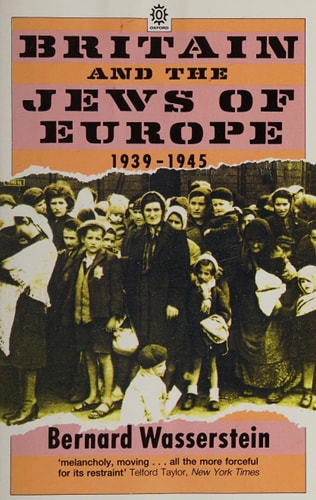
Britain and the Jews of Europe 1939-1945
0
0
As an Amazon Associate and affiliate partner, Menrva Books earns from qualifying purchases. Learn more
Author Description
This moving book provides the first serious examination of the British government's policy towards the Jews during the Second World War.Drawing on archival sources in Britain, the United States, and Israel, Bernard Wasserstein explores the reasons for the near-total war-time ban on Jewish refugee immigration to Britain, the restrictive immigration policy in Palestine, the internment and deportation of aliens in Britain, and the abortive 1943 Bermuda Conference on refugees. He also examines the reasons behind the failure to aid Jewish resistance in Europe, as well as the rejection of the scheme (supported by Winston Churchill) for the Allied bombing of Auschwitz. Wasserstein's analysis of the official records reveals a lamentable story of bureaucratic complacency, inhumanity, and blindness to the Jewish catastrophe in Europe.
Menrva's Summary
THE THESIS
This book investigates the British government's restrictive policies toward Jewish refugees and its failure to intervene effectively during the Holocaust between 1939 and 1945. Bernard Wasserstein, a historian specializing in modern Jewish history, utilizes extensive archival research from Britain, the United States, and Israel to reconstruct the decision-making processes of the British administration. He argues that bureaucratic inertia, systemic prejudice, and a lack of political will resulted in a policy of exclusion that exacerbated the plight of European Jews during the war.
THE SCOPE MAP
What You Will Find
- Analysis of British immigration policies regarding Palestine and the United Kingdom.
- Examination of the 1943 Bermuda Conference on refugees.
- Documentation of the internment and deportation of aliens within Britain.
- Investigation into the rejection of proposals to bomb Auschwitz.
Scope Limits
- The text focuses primarily on British government policy rather than the broader military history of the European theater.
- It does not provide a comprehensive history of the Holocaust itself, but rather the diplomatic and administrative response to it.
THE AUTHORITY PERSPECTIVE
Historians recognize this work as a foundational study in the field of British wartime policy and its failures regarding the Jewish catastrophe. Readers frequently note the rigorous use of primary source documentation and the sobering, clinical tone of the author's analysis.
Page Count:
400
Publication Date:
1988-12-01
Publisher:
Oxford University Press
ISBN-10:
0192821857
ISBN-13:
9780192821850
History
Political History
British History
Jewish Studies
Jews europe
European History
World War
Community Tags
Similar Books