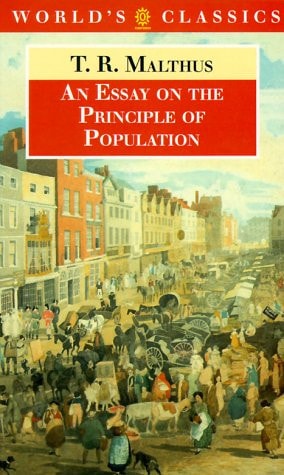
An Essay on the Principle of Population
0
0
As an Amazon Associate and affiliate partner, Menrva Books earns from qualifying purchases. Learn more
Author Description
As the world's population continues to grow at a frighteningly rapid rate, Malthus's classic warning against overpopulation gains increasing importance. An Essay on the Principle of Population (1798) examines the tendency of human numbers to outstrip their resources, and argues that checks in the form of poverty, disease, and starvation are necessary to keep societies from moving beyond their means of subsistence. Malthus's simple but powerful argument was controversial in his time; today his name has become a byword for active concern about humankind's demographic and ecological prospects.
Menrva's Summary
THE THESIS
Thomas Malthus investigates the core question of whether human population growth inevitably outpaces the production of food and resources, leading to societal collapse. Malthus, an English cleric and scholar, utilizes demographic data and historical observations to argue that population increases geometrically while food production increases only arithmetically. He posits that without preventative checks, positive checks such as famine, disease, and war are inevitable consequences of exceeding the earth's carrying capacity.
THE SCOPE MAP
What You Will Find
- A mathematical framework comparing geometric population growth to arithmetic resource growth
- Analysis of the relationship between poverty, social welfare, and population density
- Historical observations regarding demographic trends in various societies
Scope Limits
- The text does not account for the impact of future technological advancements in agriculture
- It does not explore modern contraceptive methods or complex global economic trade systems
THE AUTHORITY PERSPECTIVE
Experts recognize this work as a foundational text in the study of demography and classical economics. Readers frequently note the dense, polemical nature of the prose and its significant influence on subsequent debates regarding sustainability and social policy.
Page Count:
208
Publication Date:
1994-01-06
Publisher:
Oxford University Press
ISBN-10:
0192830961
ISBN-13:
9780192830968
Philosophy
History
Economics
Sociology
Demography
Community Tags
Other Editions(15)

Blurb, Incorporated
2019
Default edition
Blurb, Incorporated
2019
CreateSpace Independent Publishing Platform
2017

CreateSpace Independent Publishing Platform
2017
CreateSpace Independent Publishing Platform
2016

CreateSpace Independent Publishing Platform
2016

CreateSpace Independent Publishing Platform
2016

CreateSpace Independent Publishing Platform
2016

CreateSpace Independent Publishing Platform
2013
Digireads.com Publishing
2013

CreateSpace Independent Publishing Platform
2010
Oxford University Press
2008
Echo Library
2006

Echo Library
2003
Oxford University Press
1994
Similar Books




Reader Comments
Share Your Thoughts
No comments yet. Be the first to share your thoughts!