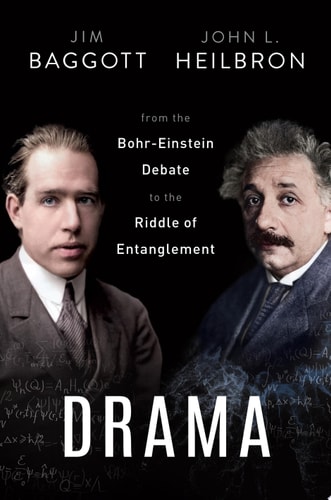
Quantum Drama: From the Bohr-Einstein Debate to the Riddle of Entanglement
0
0
As an Amazon Associate and affiliate partner, Menrva Books earns from qualifying purchases. Learn more
Author Description
The definitive account of the great Bohr-Einstein debate and its continuing legacyIn 1927, Niels Bohr and Albert Einstein began a debate about the interpretation and meaning of the new quantum theory. This would become one of the most famous debates in the history of science. At stake were an understanding of the purpose, and defense of the integrity, of science. What (if any) limits should we place on our expectations for what science can tell us about physical reality?Our protagonists slowly disappeared from the vanguard of physics, as its centre of gravity shifted from a war-ravaged Continental Europe to a bold, pragmatic, post-war America. What Einstein and Bohr had considered to be matters of the utmost importance were now set aside. Their debate was regarded either as settled in Bohr's favour or as superfluous to real physics.But the debate was not resolved. The problems of interpretation and meaning persisted, at least in the minds of a few stubborn physicists, such as David Bohm and John Bell, who refused to stop asking awkward questions. The Bohr-Einstein debate was rejoined, now with a new set of protagonists, on a small scale at first. Through their efforts, the debate was revealed to be about physics after all. Their questions did indeed have answers that could be found in a laboratory. As quantum entanglement became a real physical phenomenon, whole new disciplines were established, such as quantum computing, teleportation, and cryptography. The efforts of the experimentalists were rewarded with shares in the 2022 Nobel prize in physics.As Quantum Drama reveals, science owes a large debt to those who kept the discussions going against the apathy and indifference of most physicists before definitive experimental inquiries became possible. Although experiment moved the Bohr-Einstein debate to a new level and drew many into foundational research, it has by no means removed or resolved the fundamental question. There will be no Nobel prize for an answer.
Menrva's Summary
THE THESIS
This book investigates whether the fundamental questions regarding the interpretation of quantum mechanics, famously debated by Niels Bohr and Albert Einstein, were ever truly resolved or merely sidelined by the scientific community. Jim Baggott and John L. Heilbron utilize historical records and scientific analysis to trace the evolution of quantum theory from its early 20th-century conceptual origins to the modern era of experimental verification. The authors argue that the persistence of these foundational inquiries, maintained by a minority of physicists, eventually paved the way for modern technological advancements in quantum computing and cryptography.
THE SCOPE MAP
What You Will Find
- A detailed historical account of the Bohr-Einstein debates starting in 1927.
- Analysis of the shift in physics research from Continental Europe to post-war America.
- Examination of the contributions of David Bohm and John Bell in keeping foundational questions alive.
- Discussion of the transition from theoretical debate to experimental reality, including the 2022 Nobel Prize in Physics.
Scope Limits
- The text does not provide a definitive resolution to the philosophical questions surrounding quantum reality.
- It does not serve as a technical textbook for advanced quantum mechanics calculations.
THE AUTHORITY PERSPECTIVE
Experts and readers recognize this work as a comprehensive historical synthesis that bridges the gap between theoretical physics and the history of scientific thought. The prose is noted for its accessibility to those interested in the philosophical underpinnings of modern science without requiring a background in advanced mathematics.
Page Count:
384
Publication Date:
2024-01-01
Publisher:
Oxford University Press
ISBN-10:
0192846108
ISBN-13:
9780192846105
Science
Physics
Science History
Philosophy of
Philosophy history
Community Tags
Similar Books


Reader Comments
Share Your Thoughts
No comments yet. Be the first to share your thoughts!