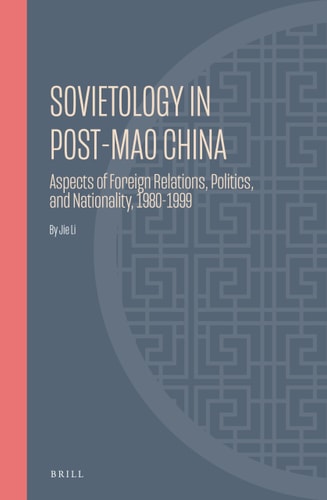
Sovietology in Post-Mao China: Aspects of Foreign Relations, Politics, and Nationality, 1980-1999
0
0
As an Amazon Associate and affiliate partner, Menrva Books earns from qualifying purchases. Learn more
Author Description
The breakup of the Union of Soviet Socialist Republics (USSR) in 1991 had significant repercussions on Chinese politics, foreign policy, and other aspects. In this book, Jie Li examines the evolution of Chinese intellectual perceptions of the Soviet Union in the 1980s and 1990s, before and after the collapse. Relying on a larger body of updated Chinese sources, Li re-evaluates many key issues in post-Mao Chinese Sovietology, arguing that the Chinese views on the Soviet Union had been influenced and shaped by the ups-and-downs of Sino-Soviet (and later Sino-Russian) relations, China’s domestic political climate, and the political developments in Moscow. By researching the country of the Soviet Union, Chinese Soviet-watchers did not focus on the USSR alone, but mostly attempted to confirm and legitimize the Chinese state policies of reform and open door in both decades. By examining the Soviet past, Chinese scholars not only demonstrated concern for the survival of the CCP regime, but also attempted to envision the future direction and position of China in the post-communist world.
Menrva's Summary
THE THESIS
This book investigates how Chinese intellectuals perceived the Soviet Union during the critical decades of the 1980s and 1990s, a period marked by significant shifts in both China and the USSR. Jie Li analyzes the evolution of Chinese Sovietology, drawing on a substantial collection of updated Chinese sources to re-evaluate key issues in post-Mao China. The study argues that Sino-Soviet relations, China's domestic political climate, and developments in Moscow all shaped Chinese perspectives. Chinese scholars, in examining the Soviet Union, sought to validate China's reform and opening-up policies and to secure the legitimacy of the Chinese Communist Party, while also contemplating China's future global standing.
THE SCOPE MAP
- Analysis of Chinese intellectual perceptions of the Soviet Union in the 1980s and 1990s.
- Examination of the impact of the USSR's breakup on Chinese politics and foreign policy.
- Re-evaluation of key issues in post-Mao Chinese Sovietology using updated Chinese sources.
- Argument that Sino-Soviet relations, China's domestic politics, and Moscow's developments influenced Chinese views.
- Exploration of how Chinese scholars used the study of the Soviet Union to legitimize domestic policies.
- Investigation into how Chinese scholars envisioned China's future in a post-communist world.
- Focus on the period before and after the collapse of the Soviet Union.
THE AUTHORITY PERSPECTIVE
The book offers a detailed examination of a specific intellectual and political field within China during a transformative era. By utilizing a broad range of Chinese sources, it aims to provide a nuanced understanding of how external events and domestic policies shaped academic and political discourse. The research highlights the strategic use of foreign analysis to bolster domestic legitimacy and chart future national direction. This work is positioned as a significant contribution to the study of post-Mao China's engagement with international affairs and its internal ideological development.
Page Count:
328
Publication Date:
2023-02-13
Publisher:
BRILL
ISBN-10:
900454092X
ISBN-13:
9789004540927
Politics
History
Non-Fiction
Soviet Studies
International relations
Asian Studies