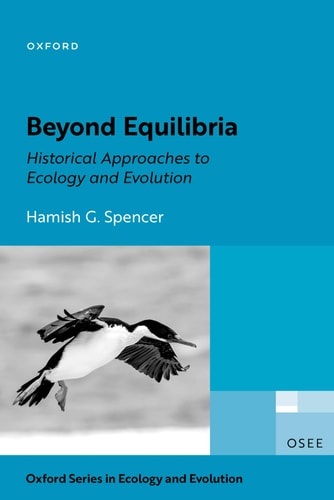
Beyond Equilibria: Historical Approaches to Ecology and Evolution (Oxford Series in Ecology and Evolution)
0
0
As an Amazon Associate and affiliate partner, Menrva Books earns from qualifying purchases. Learn more
Author Description
Integrating History Into Ecology And Evolution Argues For The Importance Of An Historical Perspective In Ecological And Evolutionary Research. Such A Viewpoint, Author Hamish Spencer Contends, Is Especially Fruitful In Theoretical Studies. Moreover, He Proposes That Recognizing The Different Ways In Which History Can Impact Study Systems, Flavors In His Terminology, Prompts Researchers To Ask Different But Insightful Questions. Different Chapters Of The Book Illustrate The Use Of Various Of These Flavors In Understanding Different Problems In Ecology And Evolution. Using Appropriate Flavors Illuminates Different Aspects Of The Study Systems, Which Can Lead To The Resolution Of Matters Previously Appearing Paradoxical. For Instance, Taking An Historical Viewpoint And Using The Flavour Of Contingency Can Explain Empirical Observations That Foraging Fish In A Patchy Environment Are Found More Often Than Expected At Poorer Feeding Sites. Similarly, The Recognition That Genetic Variation Can Build Up Over Time - History As Construction - Shows That Several Arguments Against The Role Of Natural Selection In Maintaining That Variation Are Erroneous-- Provided By Publisher.
Menrva's Summary
THE THESIS
This book investigates whether integrating historical perspectives into ecological and evolutionary research can resolve theoretical paradoxes and improve scientific inquiry. Hamish G. Spencer, a researcher in evolutionary biology, argues that history is not merely a background condition but a dynamic variable that influences biological systems. He introduces the concept of 'flavors' of history—distinct ways in which past events shape current states—to provide a structured framework for researchers to re-examine empirical data and theoretical models.
THE SCOPE MAP
What You Will Find
- A conceptual framework for categorizing historical impacts on biological systems
- Theoretical analysis of foraging behavior in patchy environments
- Re-evaluation of genetic variation maintenance models
- Case studies applying historical 'flavors' to ecological problems
Scope Limits
- The text focuses primarily on theoretical and conceptual applications rather than exhaustive empirical field data
- It does not cover the entirety of evolutionary history but focuses on specific mechanisms of historical influence
THE AUTHORITY PERSPECTIVE
Experts recognize this work as a significant contribution to the philosophy and methodology of evolutionary biology. Readers frequently note the academic density of the prose, which is best suited for researchers and students familiar with advanced ecological theory.
Page Count:
160
Publication Date:
2025-06-15
Publisher:
Oxford University Press
ISBN-10:
0192859005
ISBN-13:
9780192859006
Science
Ecology
Evolutionary Biology
Science History
Evolution
Theoretical Biology
Philosophy history
Community Tags
Similar Books