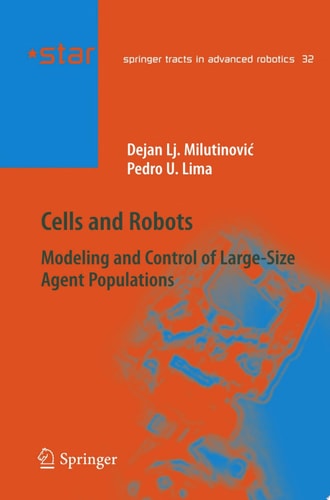
Cells and Robots: Modeling and Control of Large-Size Agent Populations
0
0
As an Amazon Associate and affiliate partner, Menrva Books earns from qualifying purchases. Learn more
Author Description
Cells and Robots is an outcome of the multidisciplinary research extending over Biology, Robotics and Hybrid Systems Theory. It is inspired by modeling reactive behavior of the immune system cell population, where each cell is considered as an independent agent. In our modeling approach, there is no difference if the cells are naturally or artificially created agents, such as robots. This appears even more evident when we introduce a case study concerning a large-size robotic population scenario. Under this scenario, we also formulate the optimal control of maximizing the probability of robotic presence in a given region and discuss the application of the Minimum Principle for partial differential equations to this problem. Simultaneous consideration of cell and robotic populations is of mutual benefit for Biology and Robotics, as well as for the general understanding of multi-agent system dynamics. The text of this monograph is based on the PhD thesis of the first author. The work was a runner-up for the fifth edition of the Georges Giralt Award for the best European PhD thesis in Robotics, annually awarded by the European Robotics Research Network (EURON).
Menrva's Summary
THE THESIS
This monograph investigates the modeling and control of large populations of agents, drawing parallels between biological systems like the immune system and artificial systems such as robots. The authors extend research from Biology, Robotics, and Hybrid Systems Theory, inspired by the modeling of reactive behavior in immune cell populations where each cell is an independent agent. They propose that there is no fundamental difference between naturally created agents (cells) and artificially created agents (robots), a concept further explored through a case study of a large robotic population. The book formulates optimal control strategies for maximizing robotic presence in a given region, applying the Minimum Principle for partial differential equations to this challenge.
THE SCOPE MAP
- Modeling of reactive behavior in biological cell populations, specifically the immune system.
- Application of agent-based modeling to both natural (biological) and artificial (robotic) systems.
- Case study on the optimal control of a large-size robotic population.
- Maximizing the probability of robotic presence in a designated region.
- Application of the Minimum Principle for partial differential equations to robotic control problems.
- Exploration of the mutual benefits for Biology and Robotics from simultaneous consideration of cell and robotic populations.
- Discussion of multi-agent system dynamics.
THE AUTHORITY PERSPECTIVE
This work is recognized as an outcome of multidisciplinary research, with the first author's PhD thesis forming its basis. The monograph was a runner-up for the Georges Giralt Award for the best European PhD thesis in Robotics, indicating a strong academic reception within the field. The approach of unifying biological and robotic agent modeling is presented as mutually beneficial for both disciplines and for the broader understanding of multi-agent systems. The text is likely to appeal to researchers and advanced students in robotics, artificial intelligence, and computational biology.
Page Count:
126
Publication Date:
2010-11-19
Publisher:
Springer Berlin Heidelberg
ISBN-10:
3642091156
ISBN-13:
9783642091155
Science
Non-Fiction
Control Theory
Robotics
Biology