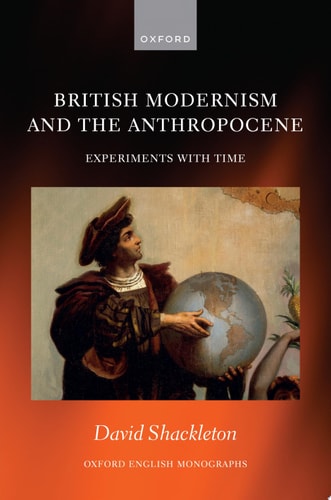
British Modernism and the Anthropocene: Experiments with Time
0
0
As an Amazon Associate and affiliate partner, Menrva Books earns from qualifying purchases. Learn more
Author Description
British Modernism and the Anthropocene: Experiments with Time assesses the environmental politics of modernism in relation to the idea of the Anthropocene―a proposed geological epoch in which humans have fundamentally changed the Earth System. The early twentieth century was marked by environmental transformations that were so complex and happened on such great scales that they defied representation. Modernist novelists responded with a range of innovative narrative forms that started to make environmental crisis on a planetary scale visible. Paradoxically, however, it is their failures to represent such a crisis that achieve the greatest success.David Shackleton explores how British modernists employed types of narrative breakdown―including fragmentation and faltering passages devoid of events―to expose the limitations of human schemes of meaning, negotiate the relationship between different scales and types of time, produce knowledge of ecological risk, and register various forms of non-human agency. Situating modernism in the context of fossil fuel energy systems, plantation monocultures, climate change, and species extinctions, Shackleton traces how H.G. Wells, D.H. Lawrence, Olive Moore, Virginia Woolf, and Jean Rhys undertook experiments with time in their novels that refigure history and the historical situations into which they were thrown. Ultimately, British Modernism and the Anthropocene shows how modernist novels provide rich resources for rethinking the current environmental crisis, and cultivating new structures of environmental care and concern.
Menrva's Summary
THE THESIS
This book investigates how early twentieth-century British modernist literature anticipated and represented the complex environmental crises associated with the Anthropocene. David Shackleton, an academic scholar, utilizes a framework of ecocriticism to analyze how modernist narrative techniques—specifically those that break down or fragment—function as tools for understanding planetary-scale ecological risk and non-human agency. By situating these texts within the history of fossil fuel dependency and industrial transformation, the author argues that modernist failures to represent environmental crisis are, in fact, their most significant contribution to contemporary ecological thought.
THE SCOPE MAP
What You Will Find
- Analysis of narrative breakdown, fragmentation, and non-event passages in modernist fiction.
- Examination of the intersection between fossil fuel energy systems and literary form.
- Case studies of H.G. Wells, D.H. Lawrence, Olive Moore, Virginia Woolf, and Jean Rhys.
Scope Limits
- The study focuses primarily on British modernist authors and does not provide a comprehensive survey of global modernist responses to climate change.
- The text is limited to the early twentieth-century period and does not extend into contemporary climate fiction.
THE AUTHORITY PERSPECTIVE
Scholars in the field of environmental humanities identify this work as a significant contribution to the study of modernist aesthetics and ecological consciousness. Readers frequently note the academic density of the prose, which is intended for an audience familiar with literary theory and historical context.
Page Count:
224
Publication Date:
2023-01-01
Publisher:
Oxford University Press
ISBN-10:
0192857746
ISBN-13:
9780192857743
British literature
English literature
Modernism
Literary Criticism
Ecocriticism
Academic
Community Tags
Similar Books