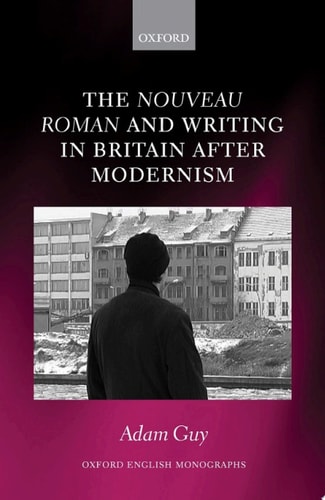
The Nouveau Roman and Writing in Britain After Modernism
0
0
As an Amazon Associate and affiliate partner, Menrva Books earns from qualifying purchases. Learn more
Author Description
The nouveau roman and Writing in Britain After Modernism recovers a neglected literary history. In the late 1950s, news began to arrive in Britain of a group of French writers who were remaking the form of the novel. In the work of Michel Butor, Marguerite Duras, Robert Pinget, Alain Robbe-Grillet, Nathalie Sarraute, and Claude Simon, the hallmarks of novelistic writing—discernible characters, psychological depth, linear chronology—were discarded in favour of other aesthetic horizons. Transposed to Britain's highly polarized literary culture, the nouveau roman became a focal point for debates about the novel. For some, the nouveau roman represented an aberration, and a pernicious turn against the humanistic values that the novel embodied. For others, it provided a route out of the stultifying conventionality and conformism that had taken root in British letters. On both sides, one question persisted: given the innovations of interwar modernism, to what extent was the nouveau roman actually new? This book begins by drawing on publishers' archives and hitherto undocumented sources from a wide range of periodicals to show how the nouveau roman was mediated to the British public. Of central importance here is the publisher Calder & Boyars, and its belief that the nouveau roman could be enjoyed by a mass public. The book then moves onto literary responses in Britain to the nouveau roman, focusing on questions of translation, realism, the end of empire, and the writing of the project. From the translations of Maria Jolas, through to the hostile responses of the circle around C. P. Snow, and onto the literary debts expressed in novels by Brian W. Aldiss, Christine Brooke-Rose, Eva Figes, B. S. Johnson, Alan Sheridan, Muriel Spark, and Denis Williams, the nouveau roman is shown to be a central concern in the postwar British literary field.
Menrva's Summary
THE THESIS
This book investigates how the French nouveau roman movement influenced and challenged the landscape of British literature during the post-modernist era. Adam Guy, a scholar of twentieth-century literature, utilizes archival research from publishers like Calder & Boyars and various periodicals to map the reception of French experimentalism in Britain. He argues that the nouveau roman served as a critical catalyst for debates regarding realism, humanism, and the evolution of the novel form in a post-imperial British context.
THE SCOPE MAP
What You Will Find
- Analysis of the reception of French authors including Robbe-Grillet, Duras, and Sarraute in Britain.
- Examination of the role of publishers like Calder & Boyars in promoting experimental fiction to a mass audience.
- Case studies on the impact of the nouveau roman on British writers such as B. S. Johnson, Muriel Spark, and Christine Brooke-Rose.
- Discussion of the intersection between translation practices and literary innovation.
Scope Limits
- The study focuses primarily on the British literary response and does not provide an exhaustive analysis of the original French texts themselves.
- It does not cover the influence of the nouveau roman on non-Anglophone literary traditions outside of the British context.
THE AUTHORITY PERSPECTIVE
Scholars and critics recognize this work as a significant contribution to the study of postwar literary history and the cross-channel exchange of aesthetic ideas. Readers frequently note the academic density of the prose and the depth of the archival research presented throughout the text.
Page Count:
256
Publication Date:
2019-01-01
Publisher:
OUP Oxford
ISBN-10:
0192589954
ISBN-13:
9780192589958
History
Criticism history
British literature
Translation Studies
English literature
Modernism
Indigenous
Literary History
Literary Criticism
Community Tags
Other Editions(2)
Similar Books




Reader Comments
Share Your Thoughts
No comments yet. Be the first to share your thoughts!