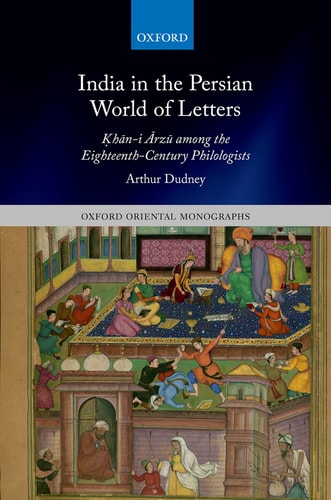
India in the Persian World of Letters: Khān-i Ārzū among the Eighteenth-Century Philologists
0
0
As an Amazon Associate and affiliate partner, Menrva Books earns from qualifying purchases. Learn more
Author Description
This is an open access title available under the terms of a CC BY-NC-ND 4.0 International licence. It is free to read at Oxford Scholarship Online and offered as a free PDF download from OUP and selected open access locations.This book traces the development of philology (the study of literary language) in the Persian tradition in India, concentrating on its socio-political ramifications. The most influential Indo-Persian philologist of the eighteenth-century was Sirāj al-Dīn 'Alī Khān, (d. 1756), whose pen-name was Ārzū. Besides being a respected poet, Ārzū was a rigorous theoretician of language whose Intellectual legacy was side-lined by colonialism. His conception of language accounted for literary innovation and historical change in part to theorize the tāzah-go'ī [literally, "fresh-speaking"] movement in Persian literary culture. Although later scholarship has tended to frame this debate in anachronistically nationalist terms (Iranian native-speakers versus Indian imitators), the primary sources show that contemporary concerns had less to do with geography than with the question of how to assess innovative "fresh-speaking" poetry, a situation analogous to the Quarrel of the Ancients and the Moderns in early modern Europe. Ārzū used historical reasoning to argue that as a cosmopolitan language Persian could not be the property of one nation or be subject to one narrow kind of interpretation. Ārzū also shaped attitudes about reḳhtah, the Persianized form of vernacular poetry that would later be renamed and reconceptualized as Urdu, helping the vernacular to gain acceptance in elite literary circles in northern India. This study puts to rest the persistent misconception that Indians started writing the vernacular because they were ashamed of their poor grasp of Persian at the twilight of the Mughal Empire.
Menrva's Summary
THE THESIS
How did eighteenth-century Indo-Persian philologists reconcile the evolution of literary language with the shifting socio-political landscape of the late Mughal Empire? Arthur Dudney, a scholar of Persian and South Asian history, examines the intellectual contributions of Sirāj al-Dīn 'Alī Khān, known as Ārzū, to argue that Indo-Persian philology was a sophisticated, cosmopolitan endeavor rather than a derivative imitation of Iranian standards. By analyzing primary texts and historical context, the author demonstrates that Ārzū’s work on the tāzah-go'ī movement and the development of reḳhtah challenged narrow nationalist interpretations of literary ownership.
THE SCOPE MAP
What You Will Find
- Analysis of eighteenth-century Indo-Persian philological treatises and poetic theory.
- Examination of the tāzah-go'ī movement and its role in literary innovation.
- Historical investigation into the transition from Persian to the early forms of Urdu.
- Comparative framework linking Indo-Persian debates to the European Quarrel of the Ancients and the Moderns.
Scope Limits
- The study focuses primarily on the intellectual legacy of Ārzū and does not provide a comprehensive history of all Mughal-era linguistic developments.
- The text does not cover the post-colonial reception of these philological works in modern Iranian literary studies.
THE AUTHORITY PERSPECTIVE
Scholars recognize this work as a significant intervention in the study of Indo-Persian literary history, particularly for its success in deconstructing colonial-era biases regarding Indian contributions to the Persian language. Readers frequently note the academic density of the prose, which is well-suited for specialists in South Asian history and Persian philology.
Page Count:
336
Publication Date:
2022-10-03
Publisher:
Oxford University Press
ISBN-10:
019285741X
ISBN-13:
9780192857415
History
Asian Studies
Asia history
Mughal Empire
Literary Criticism
Philology
Community Tags
Similar Books