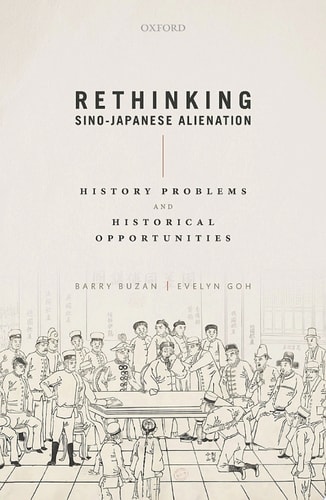
Rethinking Sino-Japanese Alienation: History Problems and Historical Opportunities
0
0
As an Amazon Associate and affiliate partner, Menrva Books earns from qualifying purchases. Learn more
Author Description
Bitterly contested memories of war, colonisation, and empire among Japan, China, and Korea have increasingly threatened regional order and security over the past three decades. In Sino-Japanese relations, identity, territory, and power pull together in a particularly lethal direction, generating dangerous tensions in both geopolitical and memory rivalries. Buzan and Goh explore a new approach to dealing with this history problem. First, they construct a more balanced and global view of China and Japan in modern world history. Second, building on this, they sketch out the possibilities for a 21st century great power bargain between them. Buzan puts Northeast Asia's history since 1840 into both a world historical and a systematic normative context, exposing the parochial nature of the China-Japan history debate in relation to what is a bigger shared story about their encounter with modernity and the West, within which their modern encounter with each other took place. Arguing that regional order will ultimately depend substantially on the relationship between these two East Asian great powers, Goh explores the conditions under which China and Japan have been able to reach strategic bargains in the course of their long historical relationship, and uses this to sketch out the main modes of agreement that might underpin a new contemporary great power bargain between them in a variety of future scenarios for the region. The frameworks adopted here consciously blend historical contextualisation, enduring concerns with wealth, power and interest, and the complex relationship between Northeast Asian states' evolving encounters with each other and with global international society.
Menrva's Summary
THE THESIS
This book investigates how the persistent historical grievances between China and Japan can be reconciled to foster a stable regional order in the 21st century. Barry Buzan and Evelyn Goh, both established scholars in international relations, utilize a framework that combines historical contextualization with realist power dynamics. They argue that the current focus on memory rivalries is parochial and that a broader, global perspective on modernity is required to facilitate a strategic great power bargain between the two nations.
THE SCOPE MAP
What You Will Find
- A systematic analysis of Northeast Asian history since 1840 within a global normative context.
- An examination of historical patterns of strategic bargaining between China and Japan.
- Theoretical frameworks for future regional cooperation and great power agreements.
Scope Limits
- The analysis does not provide a definitive policy roadmap or a guaranteed resolution to specific territorial disputes.
- The text focuses primarily on the bilateral relationship between China and Japan rather than the internal domestic politics of each nation.
THE AUTHORITY PERSPECTIVE
Experts in international relations frequently cite this work for its sophisticated integration of historical narrative and structural power theory. Readers often note the academic density of the prose, which is intended for scholars and policy analysts interested in the complexities of East Asian security architecture.
Page Count:
355
Publication Date:
2020-01-01
Publisher:
OUP Oxford
ISBN-10:
0192592114
ISBN-13:
9780192592118
History
Asian Studies
Diplomacy
Geopolitics
Asia history
International relations
Community Tags
Similar Books