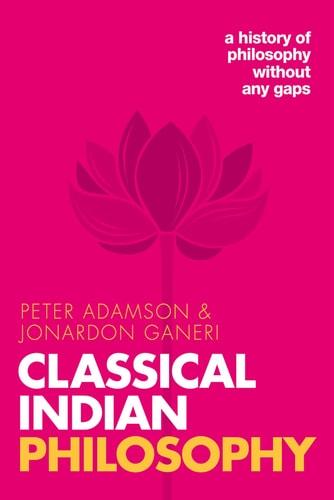
Classical Indian Philosophy: A History of Philosophy Without Any Gaps, Volume 5
0
0
As an Amazon Associate and affiliate partner, Menrva Books earns from qualifying purchases. Learn more
Author Description
Peter Adamson and Jonardon Ganeri present a lively introduction to one of the world's richest intellectual traditions: the philosophy of classical India. They begin with the earliest extant literature, the Vedas, and the explanatory works that these inspired, known as Upaniṣads. They also discuss other famous texts of classical Vedic culture, especially the Mahābhārata and its most notable section, the Bhagavad-Gīta, alongside the rise of Buddhism and Jainism. In this opening section, Adamson and Ganeri emphasize the way that philosophy was practiced as a form of life in search of liberation from suffering.Next, the pair move on to the explosion of philosophical speculation devoted to foundational texts called 'sutras,' discussing such traditions as the logical and epistemological Ny^d=aya school, the monism of Advaita Vedānta, and the spiritual discipline of Yoga.In the final section of the book, they chart further developments within Buddhism, highlighting Nagārjuna's radical critique of 'non-dependent' concepts and the no-self philosophy of mind found in authors like Dignāga, and within Jainism, focusing especially on its 'standpoint' epistemology. Unlike other introductions that cover the main schools and positions in classical Indian philosophy, Adamson and Ganeri's lively guide also pays attention to philosophical themes such as non-violence, political authority, and the status of women, while considering textual traditions typically left out of overviews of Indian thought, like the Cārvāka school, Tantra, and aesthetic theory as well.Adamson and Ganeri conclude by focusing on the much-debated question of whether Indian philosophy may have influenced ancient Greek philosophy and, from there, evaluate the impact that this area of philosophy had on later Western thought.
Menrva's Summary
THE THESIS
This volume investigates the development and core tenets of classical Indian philosophical traditions, examining how these schools functioned as both intellectual systems and practical guides for living. Peter Adamson, a professor of Late Ancient and Arabic Philosophy, and Jonardon Ganeri, a specialist in Indian philosophy, utilize a historical and thematic framework to trace the evolution of thought from the Vedas to later Buddhist and Jain developments. They argue that Indian philosophy is a multifaceted discipline that addresses existential liberation, epistemology, and social ethics through rigorous textual analysis.
THE SCOPE MAP
What You Will Find
- Historical analysis of the Vedas, Upaniṣads, Mahābhārata, and Bhagavad-Gīta.
- Examination of major schools including Nyāya, Advaita Vedānta, Yoga, and Cārvāka.
- Exploration of thematic topics such as non-violence, political authority, and the status of women.
- Comparative discussions regarding the potential influence of Indian thought on ancient Greek philosophy.
Scope Limits
- The text focuses primarily on classical traditions and does not provide an exhaustive survey of contemporary or modern Indian philosophical movements.
- It does not serve as a primary source reader, but rather as a historical synthesis of existing literature.
THE AUTHORITY PERSPECTIVE
Experts and readers frequently note the accessibility of the prose, which manages to distill complex metaphysical concepts into a readable format for non-specialists. The book is widely regarded as a comprehensive entry point for those seeking to understand the breadth of Indian intellectual history without getting lost in overly technical jargon.
Page Count:
432
Publication Date:
2022-04-27
Publisher:
Oxford University Press
ISBN-10:
019285674X
ISBN-13:
9780192856746
Philosophy
Religion
Non-Fiction
History
Asian Studies
Knowledge Theory
Indian philosophy
Community Tags
Other Editions(2)
Similar Books









Reader Comments
Share Your Thoughts
No comments yet. Be the first to share your thoughts!