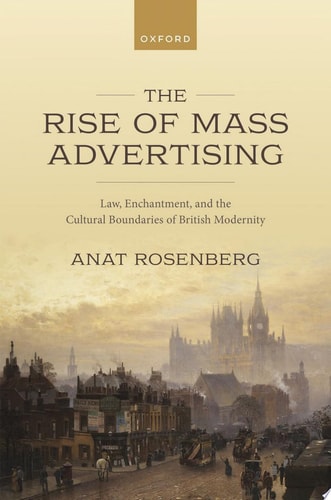
The Rise of Mass Advertising: Law, Enchantment, and the Cultural Boundaries of British Modernity
0
0
As an Amazon Associate and affiliate partner, Menrva Books earns from qualifying purchases. Learn more
Author Description
This is an open access title available under the terms of a CC BY-NC-ND 4.0 International licence. It is free to read at Oxford Scholarship Online and offered as a free PDF download from OUP and selected open access locations.The Rise of Mass Advertising is a first cultural legal history of advertising in Britain, tracing the rise of mass advertising c.1840-1914 and its legal shaping. The emergence of this new system disrupted the perceived foundations of modernity. The idea that culture was organized by identifiable fields of knowledge, experience, and authority came under strain as advertisers claimed to share values with the era's most prominent fields, including news, art, science, and religiously inflected morality. While cultural boundaries grew blurry, the assumption that the world was becoming progressively disenchanted was undermined, as enchanted experiences multiplied with the transformation of everyday environments by advertising. Magical thinking, a dwelling in mysteries, searches for transfiguration, affective connection between humans and things, and powerful fantasy disrupted assumptions that the capitalist economy was a victory of reason.The Rise of Mass Advertising examines how contemporaries came to terms with the disruptive impact by mobilizing legal processes, powers, and concepts. Law was implicated in performing boundary work that preserved the modern sense of field distinctions. Advertising's cultural meanings and its organization were shaped dialectically vis-à-vis other fields in a process that mainstreamed and legitimized it with legal means, but also construed it as an inferior simulation of the values of a progressive modernity, exhibiting epistemological shortfalls and aesthetic compromises that marked it apart from adjacent fields. The dual treatment meanwhile disavowed the central role of enchantment, in what amounted to a normative enterprise of disenchantment. One of the ironies of this enterprise was that it ultimately drove profes
Menrva's Summary
THE THESIS
This book investigates how the emergence of mass advertising in Britain between 1840 and 1914 challenged the established boundaries of modernity and how legal processes were used to manage this disruption. Anat Rosenberg, a scholar of legal history, utilizes a cultural-legal framework to analyze how advertising intersected with news, art, science, and morality. The work argues that while advertising introduced new forms of enchantment into everyday life, the law functioned to categorize and contain these influences to maintain a sense of rational order.
THE SCOPE MAP
What You Will Find
- A cultural legal history of British advertising from 1840 to 1914.
- Analysis of the dialectical relationship between advertising and other cultural fields.
- Examination of how legal concepts were mobilized to define the boundaries of modern experience.
Scope Limits
- The study is geographically restricted to Britain.
- The analysis focuses primarily on the period ending at the onset of World War I.
THE AUTHORITY PERSPECTIVE
Scholars in the field of legal history and cultural studies recognize this work as a significant contribution to understanding the intersection of commerce and regulation. Readers frequently note the academic density of the prose and the depth of the historical research presented.
Page Count:
432
Publication Date:
2022-12-22
Publisher:
Oxford University Press
ISBN-10:
0192858912
ISBN-13:
9780192858917
History
Advertising history
Special Topics
Legal History
British History
Modernity
Community Tags
Similar Books