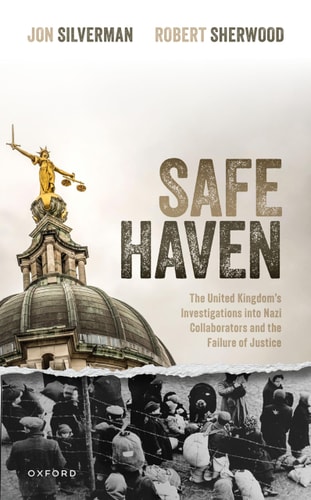
Safe Haven: The United Kingdom's Investigations into Nazi Collaborators and the Failure of Justice
0
0
As an Amazon Associate and affiliate partner, Menrva Books earns from qualifying purchases. Learn more
Author Description
The controversial 1991 War Crimes Act gave new powers to courts to try non-British citizens resident in the UK for war crimes committed during WWII. But in spite of the extensive investigative and legal work that followed, and the expense of some £11 million, it led to just one conviction: that in 1999 of Anthony (Andrzej) Sawoniuk.Drawing on previously unavailable archival documents, transcripts of interviews with suspects, and disclosures by senior lawyers and policer offers in the War Crimes Units (WCUs), in parallel with the history of bungled investigations in the 1940s, Safe Haven considers for the first time why and how convictions failed to follow investigations. Within the broader context of war crimes investigations in the United States, Germany, and Australia, the authors reassess the legal and investigative processes and decisions that stymied inquiries, from the War Crimes Act itself to the restrictive criteria applied to it. Taken together, the authors argue that these -- including the interpretations of who could and should be prosecuted and decisions about the nature and amount of evidence needed for trial -- meant that many Nazi collaborators escaped justice and never appeared in a criminal court.The authors situate this history within the legacy of the Holocaust: how, if at all, do the belated attempts to address a failure of justice sit with an ever-growing awareness of the Holocaust, represented by memorialization and education? In so doing, Safe Haven provokes a timely reconsideration of the relationship between law, history, and truth.
Menrva's Summary
THE THESIS
This book investigates why the United Kingdom’s extensive legal and investigative efforts to prosecute Nazi collaborators following the 1991 War Crimes Act resulted in only a single conviction. Authors Jon Silverman and Robert Sherwood, drawing on their expertise in legal reporting and historical research, analyze the systemic, political, and evidentiary failures that prevented the successful prosecution of war criminals residing in Britain. They argue that restrictive legal criteria and bureaucratic inertia effectively shielded many individuals from accountability, creating a significant gap between historical truth and judicial outcomes.
THE SCOPE MAP
What You Will Find
- Analysis of the 1991 War Crimes Act and its implementation challenges.
- Comparative study of war crimes investigations in the United States, Germany, and Australia.
- Examination of archival documents and transcripts from the War Crimes Units.
- Review of the historical context of post-war investigations dating back to the 1940s.
Scope Limits
- The text does not provide a comprehensive biography of every individual suspect investigated.
- It does not offer a definitive legal roadmap for future international war crimes prosecutions.
THE AUTHORITY PERSPECTIVE
Experts and historians recognize this work as a critical examination of the intersection between legislative intent and judicial failure in the British legal system. Readers frequently note the meticulous use of primary source material to expose the structural limitations that hindered the pursuit of justice for Holocaust-era crimes.
Page Count:
336
Publication Date:
2024-01-01
Publisher:
Oxford University Press
ISBN-10:
0192855174
ISBN-13:
9780192855176
History
True Crime
Legal History
World War
Europe
Community Tags
Similar Books