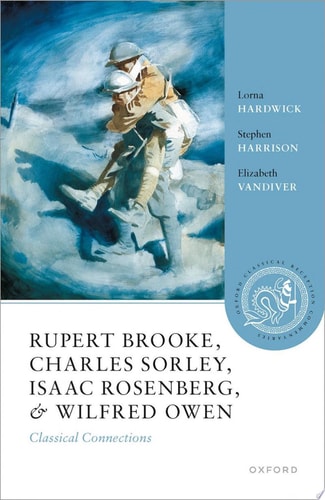
Rupert Brooke, Charles Sorley, Isaac Rosenberg, and Wilfred Owen: Classical Connections
0
0
As an Amazon Associate and affiliate partner, Menrva Books earns from qualifying purchases. Learn more
Author Description
This Book Examines How, When And Why Four First World War Poets Engaged With Greek And Roman Antiquity. Rupert Brooke, Wilfred Owen, Isaac Rosenberg And Charles Sorley All Died In The War. They Came From Diverse Social, Educational And Cultural Backgrounds But For All Of The Writers Engagement With Classical Material Was Decisive In Shaping Their War Poetry The World Views And Cultural Hinterlands Of Brooke And Sorley Were Framed By The Greek And Latin Texts They Had Studied At School, Whereas For Owen, Who Struggled With Latin, Classical Texts Were A Part Of His Aspirational Literary Imagination. Rosenberg's Education Was Limited But He Encountered Some Greek And Roman Literature Through Translations, And Through Mediations In English Literature. The Various Ways In Which The Poets Engaged With Classical Literature Are Analysed In The Commentaries, Which Are Designed To Be Accessible To Classicists And To Users From Other Subject Areas. The Extensive Range Of Connections Made By The Poets And By Subsequent Readers Is Explained In The Introduction To The Volume. The Commentaries Illuminate Relationships Between The Poems And Attitudes To The War At The Time, In The Immediate Post-war Years, And Subsequently. They Also Probe How Individual Poems Reveal Various Facets Of The Poetry Of Unease, The Poetry Of Survival, And The Poetics Of War And Ecology. Links To The Online Oxford Classical Receptions Commentaries Will Enable Readers To Follow Up Their Special Interests. This Volume Differs From The Shorter Volume Greek And Roman Antiquity In First World War Poetry; Making Connections In That It Covers The Whole Output Of The Four Poets, And Not Just Their War Poems-- Provided By Publisher.
Menrva's Summary
THE THESIS
This volume investigates the specific ways in which four prominent First World War poets—Rupert Brooke, Charles Sorley, Isaac Rosenberg, and Wilfred Owen—integrated Greek and Roman antiquity into their literary output. The authors, Lorna Hardwick, Stephen J. Harrison, and Elizabeth Vandiver, utilize a comparative framework to analyze how these poets, despite their disparate educational and social backgrounds, employed classical references to shape their perceptions of conflict and cultural identity. By examining both their war poetry and their broader literary contributions, the text argues that classical engagement served as a critical lens through which these writers processed the trauma and reality of the Great War.
THE SCOPE MAP
What You Will Find
- Comparative analysis of four poets with varying levels of classical education.
- Examination of the influence of Greek and Latin texts on war poetry and broader literary output.
- Discussion of the 'poetry of unease' and 'poetics of war and ecology' as thematic frameworks.
- Integration with the online Oxford Classical Receptions Commentaries for further research.
Scope Limits
- The analysis is restricted to the specific works and classical engagements of these four poets.
- The text does not provide a general history of the war itself, focusing instead on the intersection of classical reception and poetic expression.
THE AUTHORITY PERSPECTIVE
Experts identify this volume as a significant contribution to the study of classical reception in modern literature, noting its utility for both classicists and scholars of twentieth-century poetry. Readers frequently highlight the academic rigor of the commentaries and the value of the comparative approach in understanding the diverse intellectual backgrounds of the poets.
Page Count:
352
Publication Date:
2024-01-01
Publisher:
Oxford University Press
ISBN-10:
0192856677
ISBN-13:
9780192856678
History
Poetry
Literary Criticism
World War
Academic
Criticism & Theory
Community Tags
Other Editions(2)
Similar Books
Reader Comments
Share Your Thoughts
No comments yet. Be the first to share your thoughts!