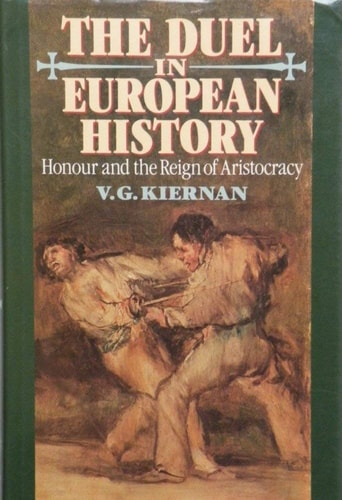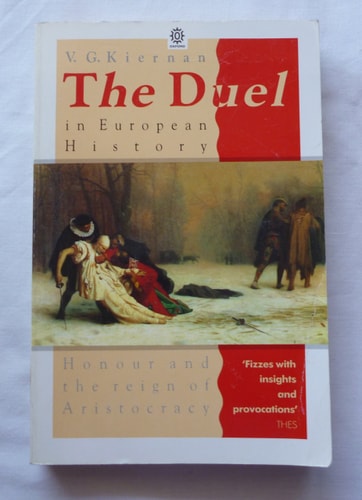
The Duel in European History: Honour and the Reign of Aristocracy
0
0
As an Amazon Associate and affiliate partner, Menrva Books earns from qualifying purchases. Learn more
Author Description
The romance and drama of the duel has made it an enduring attraction in novels, plays, and operas; but it takes on a deeper significance when considered in its social, evolutionary setting. From medieval times, the privilege of duelling was regarded as a badge of rank, an assertion of preeminence by Europe's dominant classes. This book describes the evolution of the duel from its medieval origins to the early 20th century. It also looks at the opinions about duelling in different areas and historical eras, as reflected in legislation, church pronouncements, and the works of writers such as Montesquieu and Walter Scott. Kiernan discusses the duel as something unique to Europe and its colonies, its practice in Ireland and Scotland compared with English practice, what women thought of it, and how it contributed to the development of an officer corps, throwing new light on the long ascendancy of aristocratic classes and their values in European history.
Menrva's Summary
THE THESIS
This book investigates the duel as a socio-political instrument used by the European aristocracy to maintain status and define class boundaries across several centuries. V. G. Kiernan, a historian specializing in European social structures, utilizes a wide array of primary sources—including legal codes, ecclesiastical decrees, and literary critiques—to argue that the duel was not merely a romanticized conflict but a functional mechanism for preserving aristocratic hegemony. The text examines how this practice evolved from medieval judicial combat into a refined code of honor that persisted until the early 20th century.
THE SCOPE MAP
What You Will Find
- An analysis of the duel's evolution from medieval origins to the early 20th century.
- Comparative studies of dueling practices in England, Ireland, and Scotland.
- Examination of the duel's role in the formation of professional officer corps.
- Perspectives on the practice from contemporary writers, church officials, and women of the era.
Scope Limits
- The text focuses primarily on European contexts and their direct colonial extensions.
- It does not provide an exhaustive technical manual on the mechanics of swordplay or pistol marksmanship.
THE AUTHORITY PERSPECTIVE
Historians and sociologists frequently cite this work as a foundational text for understanding the intersection of honor culture and class stratification in Europe. Readers often note the academic density of the prose, which provides a rigorous examination of how social values were codified through violence.
Page Count:
368
Publication Date:
1989-12-07
Publisher:
Oxford University Press
ISBN-10:
0192851284
ISBN-13:
9780192851284
History
European History
Sociology
Military History
Aristocracy
Social History
Dueling
Community Tags
Similar Books