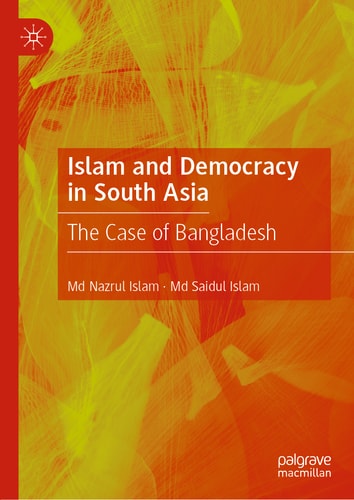
Islam and Democracy in South Asia: The Case of Bangladesh
0
0
As an Amazon Associate and affiliate partner, Menrva Books earns from qualifying purchases. Learn more
Author Description
Grounded in the Weberian tradition, Islam and Democracy in South Asia: The Case of Bangladesh presents a critical analysis of the complex relationship between Islam and democracy in South Asia and Bangladesh. The book posits that Islam and democracy are not necessarily incompatible, but that the former has a contributory role in the development of the latter. Islam came to Bengal largely by Sufis and missionaries through peaceful means and hence a moderate form of this religion got rooted in the society. Both militant Islam and militant secularism are equal threats to democracy and pluralism. Like democracy, political Islam has many faces. Political Islam adhering to democratic norms and practices, what the authors call "democratic Islamism," unlike "militant Islamism," is not anti-democratic. The book shows that the suppression of democracy and human rights creates avenues for the consolidation of militant Islamism, orthodox Islam, and "Islamic" terrorism, while the "fair play" of democracy results in the decline of anti-democratic form of political Islam.
Menrva's Summary
THE THESIS
This book critically analyzes the intricate relationship between Islam and democracy in South Asia, with a specific focus on Bangladesh. It argues that Islam and democracy are not inherently contradictory, and that Islam can play a constructive role in democratic development. The authors contend that the peaceful arrival of Islam in Bengal, largely through Sufis, fostered a moderate religious tradition. They identify both militant Islam and militant secularism as significant threats to democracy and pluralism, asserting that 'democratic Islamism,' which adheres to democratic norms, stands in contrast to 'militant Islamism' and is not anti-democratic.
THE SCOPE MAP
- Analysis of the historical development of Islam in Bengal and its societal impact.
- Examination of the compatibility of Islam and democratic principles.
- Distinction between 'democratic Islamism' and 'militant Islamism'.
- Exploration of how the suppression of democracy can foster militant Islamism and terrorism.
- Argument that fair democratic practices can lead to the decline of anti-democratic forms of political Islam.
- Case study of Bangladesh as a focal point for these complex interactions.
THE AUTHORITY PERSPECTIVE
The book is grounded in the Weberian tradition and presents a critical analysis of the relationship between Islam and democracy in South Asia, particularly in Bangladesh. It posits that Islam can contribute to the development of democracy, contrasting 'democratic Islamism' with 'militant Islamism.' The authors suggest that the suppression of democratic rights can create fertile ground for militant Islamism and terrorism, while the practice of fair democracy can diminish anti-democratic political Islam.
Page Count:
331
Publication Date:
2020-03-20
Publisher:
Springer International Publishing
ISBN-10:
3030429091
ISBN-13:
9783030429096
Non-Fiction
Religion
Politics
Islam
Sociology
Democracy
Community Tags
Similar Books