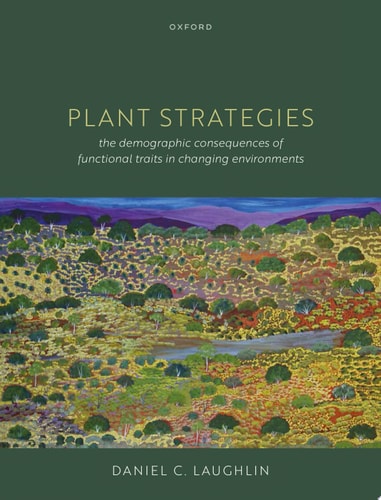
Plant Strategies: The Demographic Consequences of Functional Traits in Changing Environments
0
0
As an Amazon Associate and affiliate partner, Menrva Books earns from qualifying purchases. Learn more
Author Description
How do plants make a living? Some plants are gamblers, others are swindlers. Some plants are habitual spenders while others are strugglers and miserly savers. Plants have evolved a spectacular array of solutions to the existential problems of survival and reproduction in a world where resources are scarce, disturbances can be deadly, and competition is cut-throat. Few topics have both captured the imagination and furrowed the brows of plant ecologists, yet no topic is more important for understanding the assembly of plant communities, predicting plant responses to global change, and enhancing the restoration of our rapidly degrading biosphere. The vast array of plant strategy models that characterize the discipline now require synthesis. These models tend to emphasize either life history strategies based on demography, or functional strategies based on ecophysiology. Indeed, this disciplinary divide between demography and physiology runs deep and continues to this today.The goal of this accessible book is to articulate a coherent framework that unifies life history theory with comparative functional ecology to advance prediction in plant ecology. Armed with a deeper understanding of the dimensionality of life history and functional traits, we are now equipped to quantitively link phenotypes to population growth rates across gradients of resource availability and disturbance regimes. Predicting how species respond to global change is perhaps the most important challenge of our time. A robust framework for plant strategy theory will advance this research agenda by testing the generality of traits for predicting population dynamics.
Menrva's Summary
THE THESIS
This book investigates how to unify life history theory with comparative functional ecology to predict plant population dynamics in changing environments. Author Daniel C. Laughlin addresses the long-standing disciplinary divide between demographic and physiological approaches to plant strategy. By synthesizing these models, the text provides a quantitative framework for linking plant phenotypes to population growth rates across varying resource and disturbance gradients.
THE SCOPE MAP
What You Will Find
- A unified theoretical framework for plant strategy models
- Quantitative methods for linking functional traits to population growth
- Analysis of plant responses to resource availability and disturbance regimes
- Synthesis of life history theory and ecophysiology
Scope Limits
- Does not provide a comprehensive field guide to specific plant species
- Does not cover non-plant ecological systems
THE AUTHORITY PERSPECTIVE
Experts recognize this work as a significant attempt to bridge the gap between disparate sub-disciplines in plant ecology. Readers frequently note the technical rigor of the proposed framework, which serves as a resource for researchers focused on predicting vegetation responses to global environmental change.
Page Count:
464
Publication Date:
2023-01-01
Publisher:
Oxford University Press
ISBN-10:
0192867946
ISBN-13:
9780192867940
Science
Life sciences
Botany
Plant Biology
Ecology
Community Tags
Similar Books