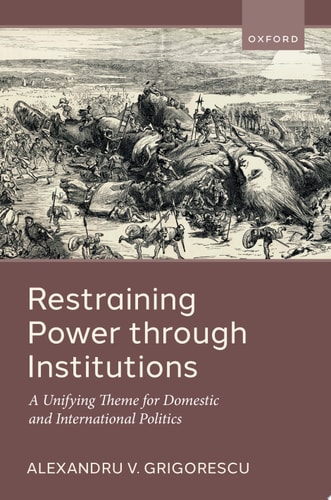
Restraining Power through Institutions: A Unifying Theme for Domestic and International Politics
0
0
As an Amazon Associate and affiliate partner, Menrva Books earns from qualifying purchases. Learn more
Author Description
This book challenges the traditional view that meaningful analogies cannot be drawn between domestic and international politics. Alexandru V. Grigorescu shows that there are important parallels to be drawn across these two realms, if political interactions among states over the past two centuries are compared to those within states going back about a thousand years. He focuses specifically on the evolution of institutions that restrain concentrated power, such as courts, assemblies, and bureaucracies.Restraining Power through Institutions begins by developing a set of theoretical arguments about the emergence, change, and consolidation of institutional restraints on power. These are primarily derived from literature focusing on domestic politics going back to events such as those surrounding the signing of the Magna Carta and the emergence and evolution of the Curia Regis in England, or of the Estates General and Parlements in France. It then assesses the relevance of such arguments for the evolution of numerous international institutions: international courts, such as the Permanent Court of Arbitration, International Court of Justice, and International Criminal Court; international assemblies and parliaments, such as the Assembly of the League of Nations, UN General Assembly; and European Parliament; and international secretariats, such as those of the Central Commission for the Navigation of the Rhine, League of Nations, UN, and World Bank.The similarities between developments in the domestic and international realms lead to a number of important conclusions about future expectations for international institutions and for world politics more broadly. In particular, the book argues that complementing the traditional focus on efforts to acquire power with the "Lockean" focus on restraining power offers a more complete depiction of international politics. This novel perspective consequently shifts the focus from the interests and actions of a handful of powerful stat
Menrva's Summary
THE THESIS
This book investigates whether the mechanisms used to restrain concentrated power within domestic states can be effectively applied to understand the evolution and function of international institutions. Alexandru V. Grigorescu, a scholar of international relations, synthesizes historical data from domestic political development—spanning nearly a millennium—with two centuries of international institutional growth. He argues that by shifting the analytical focus from power acquisition to power restraint, scholars can identify consistent patterns that bridge the divide between domestic and international political theory.
THE SCOPE MAP
What You Will Find
- A comparative framework linking domestic institutions like the Magna Carta and the Curia Regis to international bodies.
- Analysis of international courts, including the Permanent Court of Arbitration and the International Criminal Court.
- Examination of international assemblies such as the UN General Assembly and the European Parliament.
- Study of international secretariats like the World Bank and the League of Nations.
Scope Limits
- The analysis does not cover non-institutional forms of power restraint, such as informal social norms or military deterrence.
- The study focuses primarily on Western-centric institutional models rather than non-Western governance structures.
THE AUTHORITY PERSPECTIVE
Experts in political science recognize this work as a significant contribution to the comparative study of domestic and international governance. Readers frequently note the academic density of the prose, which is intended for scholars and advanced students of international relations theory.
Page Count:
320
Publication Date:
2024-01-01
Publisher:
Oxford University Press
ISBN-10:
0192863681
ISBN-13:
9780192863683
Governance
Comparative Government
Political History
International relations
Community Tags
Similar Books