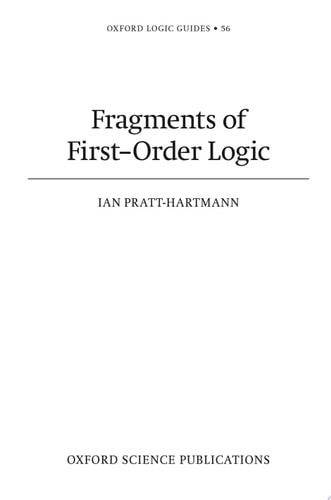
Fragments of First-Order Logic
0
0
As an Amazon Associate and affiliate partner, Menrva Books earns from qualifying purchases. Learn more
Author Description
A sentence of first-order logic is satisfiable if it is true in some structure, and finitely satisfiable if it is true in some finite structure. The question arises as to whether there exists an algorithm for determining whether a given formula of first-order logic is satisfiable, or indeed finitely satisfiable. This question was answered negatively in 1936 by Church and Turing (for satisfiability) and in 1950 by Trakhtenbrot (for finite satisfiability).In contrast, the satisfiability and finite satisfiability problems are algorithmically solvable for restricted subsets---or, as we say, fragments---of first-order logic, a fact which is today of considerable interest in Computer Science. This book provides an up-to-date survey of the principal axes of research, charting the limits of decision in first-order logic and exploring the trade-off between expressive power and complexity of reasoning.Divided into three parts, the book considers for which fragments of first-order logic there is an effective method for determining satisfiability or finite satisfiability. Furthermore, if these problems are decidable for some fragment, what is their computational complexity? Part I focusses on fragments defined by restricting the set of available formulas. Topics covered include the Aristotelian syllogistic and its relatives, the two-variable fragment, the guarded fragment, the quantifier-prefix fragments and the fluted fragment. Part II investigates logics with counting quantifiers. Starting with De Morgan's numerical generalization of the Aristotelian syllogistic, we proceed to the two-variable fragment with counting quantifiers and its guarded subfragment, explaining the applications of the latter to the problem of query answering in structured data. Part III concerns logics characterized by semantic constraints, limiting the available interpretations of certain predicates. Taking propositional modal logic and graded modal logic as our cue, we return to the satisfiability pro
Menrva's Summary
THE THESIS
This book investigates the boundaries of decidability and computational complexity within specific fragments of first-order logic. The author, Ian Pratt-Hartmann, synthesizes historical developments in logic with modern computational theory to evaluate which subsets of first-order logic allow for effective algorithmic determination of satisfiability and finite satisfiability. The text provides a rigorous framework for understanding the trade-offs between the expressive power of logical formulas and the resources required to compute their truth values.
THE SCOPE MAP
What You Will Find
- Analysis of fragments defined by formula restrictions, including Aristotelian syllogistic, two-variable fragments, and the guarded fragment.
- Investigation of logics incorporating counting quantifiers and their application to structured data query answering.
- Examination of semantic constraints and their relationship to propositional and graded modal logics.
Scope Limits
- The text does not provide an exhaustive survey of all possible logical systems, focusing instead on those with clear decision-procedure relevance.
- It assumes a foundational understanding of formal logic and does not serve as an introductory textbook for novice students.
THE AUTHORITY PERSPECTIVE
Experts recognize this work as a comprehensive reference for researchers in theoretical computer science and mathematical logic. Readers frequently note the high level of technical density, which makes the text most suitable for those already familiar with the principles of decidability and complexity theory.
Page Count:
672
Publication Date:
2023-06-30
Publisher:
Oxford University Press
ISBN-10:
0192867962
ISBN-13:
9780192867964
Philosophy of
Computer Science
Logic
Computational complexity
Mathematics
Formal Methods
Community Tags
Other Editions(2)
Similar Books



Reader Comments
Share Your Thoughts
No comments yet. Be the first to share your thoughts!