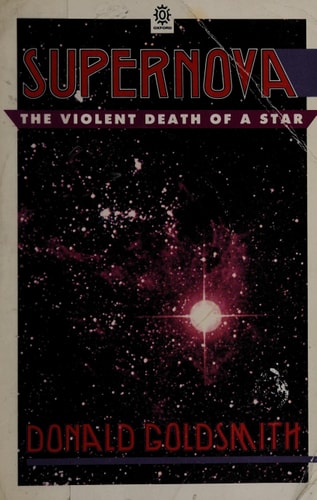
Supernova: The Violent Death of a Star
0
0
As an Amazon Associate and affiliate partner, Menrva Books earns from qualifying purchases. Learn more
Author Description
Nearly 160,000 years ago, a star in the Large Magellanic Cloud (a galaxy close to our own Milky Way) erupted in a majestic, violent death. Traveling at the speed of light, the radiation from this explosion reached Earth on February 23, 1987. The brightest supernova seen in four centuries, it was one of the most significant discoveries of twentieth-century astronomy.The saga of Supernova "1987A" began with a once-in-a-lifetime observation by a lone astronomer in the Andes mountains. Astronomers soon found that the death throes of a far-off sun had yielded a treasure trove of information. This lucid, fascinating account by one of today's leading writers on astronomy details the results these astronomers obtained and the basic conclusions they drew.The story that Donald Goldsmith tells spans the globe from satellites orbiting high above the Earth as they detect bursts of gamma rays and X rays, to "Neutrino" experts capturing a few of these elusive subatomic particles in water-filled chambers deep underground, to the creation of supernova "models" in supercomputers. Taking us to the scene of this spectacular astronomical event and to the various locations of its aftermath, Goldsmith recalls our historical fascination with supernovae; explains how stars form and then live through nuclear fusion; reveals a star's different kinds of electromagnetic radiation; and demonstrates how exploding stars transform primordial material into complex elements essential to life on Earth.Readers of Supernova will gain a heightened awareness of the universe and our role in it.
Menrva's Summary
THE THESIS
This book investigates the scientific significance of Supernova 1987A and how its observation transformed modern understanding of stellar evolution. Donald Goldsmith, a prominent science writer, utilizes the 1987 event as a focal point to explain complex astrophysical processes. He synthesizes data from global observatories and theoretical models to argue that the death of stars is the primary mechanism for distributing elements necessary for life throughout the universe.
THE SCOPE MAP
What You Will Find
- Detailed analysis of the 1987A supernova observation
- Explanations of nuclear fusion and stellar life cycles
- Overview of detection methods including neutrino capture and satellite-based X-ray monitoring
- Discussion on the synthesis of heavy elements in exploding stars
Scope Limits
- Does not provide a comprehensive history of all known supernovae
- Does not offer advanced mathematical proofs for stellar modeling
THE AUTHORITY PERSPECTIVE
Experts and readers alike identify this work as a highly accessible entry point into the mechanics of stellar death. The text is frequently cited for its ability to translate complex astronomical data into a clear, chronological narrative for the general public.
Page Count:
240
Publication Date:
1990-12-20
Publisher:
Oxford University Press
ISBN-10:
0192861166
ISBN-13:
9780192861160
Non-Fiction
Science
Astrophysics
Supernovae
Astronomy
Community Tags
Similar Books