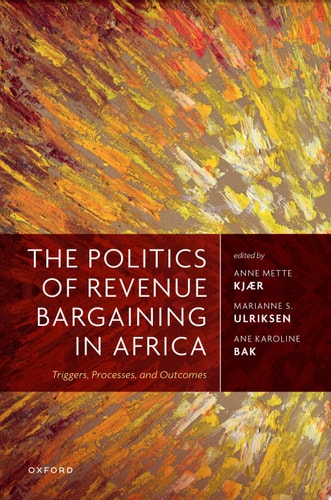
The Politics of Revenue Bargaining in Africa: Triggers, Processes, and Outcomes
0
0
As an Amazon Associate and affiliate partner, Menrva Books earns from qualifying purchases. Learn more
Author Description
This is an open access title available under the terms of a CC BY-NC-ND 4.0 International licence. It is free to read at Oxford Academic and offered as a free PDF download from OUP and selected open access locations.This book examines the politics of revenue bargaining in Africa at a time when attention to domestic revenue mobilization has expanded immensely. Measures to increase taxes and other revenues can - but do not always - lead to a process of bargaining, where revenue providers negotiate for some kind of return. This book offers in-depth analyses of micro-instances of revenue bargaining across five African countries: Mozambique, Senegal, Tanzania, Togo, and Uganda. The case studies all draw on a common theoretical framework combining the fiscal contract theory with the political settlement approach, which enables a systematic exploration into what triggers revenue bargaining; how these processes unfold; and finally, if and when they result in an agreement - whether that is a fiscal contract or not. From these empirically rich case narratives emerges a story of how power and initial bargaining position influence not only whether bargaining occurs in the first place, but also the processes and their outcomes. Less resourceful taxpayers find it harder to raise their voice, but in some cases even these groups manage to ally with other civil society groups to protest tax reforms they perceive as unfair. Indirect taxes such as VAT often trigger protests, as do sudden changes in tax practices. Revenue providers rarely call for improved services in return for paying tax, which would be expected to nurture the foundation for a fiscal social contract. Instead, revenue providers are more likely to negotiate for tax reductions, implying that governments' efforts to increase revenue are impeded. Indeed, we find many instances of state-society reciprocity when ruling elites try to be responsive to revenue providers' demands.
Menrva's Summary
THE THESIS
This book investigates the conditions under which domestic revenue mobilization in Africa triggers bargaining processes between state actors and taxpayers. The editors, drawing on a multidisciplinary team of researchers, utilize a theoretical framework that synthesizes fiscal contract theory with the political settlement approach. By examining micro-instances of tax negotiation, the text argues that power dynamics and initial bargaining positions are the primary determinants of whether revenue collection leads to a functional fiscal social contract or merely to resistance and tax reduction demands.
THE SCOPE MAP
What You Will Find
- Comparative case studies of Mozambique, Senegal, Tanzania, Togo, and Uganda.
- Analysis of the triggers for tax-related protests, specifically regarding VAT and sudden policy shifts.
- A framework for evaluating state-society reciprocity and the responsiveness of ruling elites to taxpayer demands.
Scope Limits
- The study focuses on micro-level bargaining instances rather than broad macroeconomic fiscal policy.
- The research does not provide a comprehensive survey of all African nations, limiting its scope to the five selected countries.
THE AUTHORITY PERSPECTIVE
Experts identify this work as a significant contribution to the study of fiscal sociology and political economy in the Global South. Readers frequently note the academic density of the prose, which is intended for scholars and policy analysts interested in the intersection of state-building and taxation.
Page Count:
336
Publication Date:
2024-01-01
Publisher:
Oxford University Press
ISBN-10:
0192868780
ISBN-13:
9780192868787
Economics
Politics
Public Policy
Systems Theory
Economic Policy & Development
Taxation
Community Tags
Similar Books









Reader Comments
Share Your Thoughts
No comments yet. Be the first to share your thoughts!