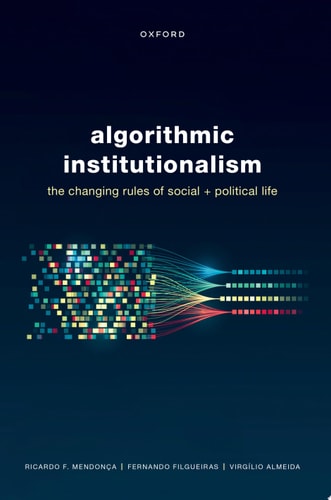
Algorithmic Institutionalism: The Changing Rules of Social and Political Life
0
0
As an Amazon Associate and affiliate partner, Menrva Books earns from qualifying purchases. Learn more
Author Description
Algorithmic Institutionalism is the first book to conceive algorithms as institutions in contemporary societies, focusing on different dimensions of how they structure decision-making and enact power relations. In many situations in contemporary societies, algorithms structure social interactions, resulting in patterns of action and human behavior in collective contexts. Almeida, Filgueiras, and Mendonca discuss how algorithms are gradually occupying an institutional space in societies, deciding on different aspects of social life and shaping collective and individual human behaviors.As institutions, algorithms work as decision systems that define what is allowed, hindered, facilitated, or made impossible as well as positions within society's organizational structures. Algorithmic institutionalism uses the perspective of institutional theories to explain the functioning of these decision systems and how they establish patterns and norms that affect human behavior and lead to deep changes in contemporary society. The book points to the challenges of political orders that are gradually institutionalized with algorithms, comprising new dynamics of interaction between humans and machines. These disruptive dynamics of interaction between humans and machines create new challenges related to the democratization of algorithms and the impasses that emerge with technological advancement through digital technologies.Providing an analytical framework for an adequate comprehension of the social and political implications of algorithmic systems, Algorithmic institutionalism applies this framework to make sense of recommendation systems, the platformization of governments, and the deployment of algorithms in security. It then addresses the challenge of developing approaches to democratize the new political order influenced by the global expansion of algorithmic decision-making, pointing to key democratic values that are relevant once we consider the construction of legitimate deci
Menrva's Summary
THE THESIS
This book investigates the proposition that algorithms function as modern institutions that structure social and political life by defining decision-making parameters and power dynamics. The authors, Professors Fernando Filgueiras, Virgilio Almeida, and Ricardo F. Mendonça, utilize institutional theory to analyze how automated systems establish norms and behavioral patterns. By examining the intersection of human interaction and machine logic, the text argues that algorithms have become central to the governance of contemporary society and the maintenance of political order.
THE SCOPE MAP
What You Will Find
- An analytical framework for understanding algorithms as institutional decision systems
- Case studies on recommendation systems and the platformization of government services
- Analysis of algorithmic deployment in security and law enforcement
- Strategies for the democratization of algorithmic decision-making processes
Scope Limits
- The text does not provide a technical manual for coding or developing specific algorithms
- It does not focus on the hardware or physical infrastructure of digital networks
THE AUTHORITY PERSPECTIVE
Experts identify this work as a significant contribution to the study of digital governance and the sociopolitical impact of automation. Readers frequently note the academic rigor of the prose, which provides a structured approach to complex questions regarding machine-led institutional change.
Page Count:
192
Publication Date:
2024-01-01
Publisher:
Oxford University Press
ISBN-10:
0192870076
ISBN-13:
9780192870070
Politics
Public Policy
Technology and Society
Institutional Theory
Sociology
Community Tags
Similar Books












Reader Comments
Share Your Thoughts
No comments yet. Be the first to share your thoughts!