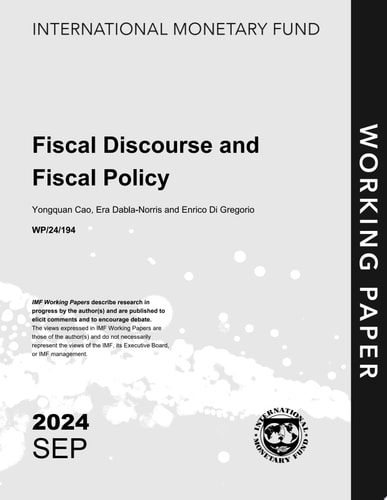
Fiscal Discourse and Fiscal Policy
0
0
As an Amazon Associate and affiliate partner, Menrva Books earns from qualifying purchases. Learn more
Author Description
We study the supply of fiscal ideas leveraging thousands of electoral platforms from 65 countries in the Manifesto Project to link how political parties discuss fiscal policy with fiscal outcomes. We provide three sets of results. First, fiscal discourse has become increasingly favourable to higher government spending since at least the 1990s in advanced and emerging economies and across the political spectrum. This pattern does not track survey trends in voter preferences, suggesting that parties have played a role in shifting the focus of political campaigns to fiscal issues to win over voters. Second, fiscal discourse turns conservative under more adverse fiscal conditions, including in the aftermath of debt surges and after the adoption of fiscal rules, but only to a limited extent. Third, over the medium-run, relative discourse changes in favor of government expansion and away from fiscal restraint are followed by higher fiscal deficits. Together, our results suggest that adverse shifts in the supply of fiscal ideas could add to fiscal pressures over time.
Menrva's Summary
THE THESIS
This study investigates how political discourse shapes fiscal policy by analyzing the supply of fiscal ideas through electoral platforms. The authors leverage data from thousands of electoral platforms across 65 countries, linking party discussions on fiscal policy to actual fiscal outcomes. Their findings indicate a consistent trend since the 1990s towards increased government spending, a shift not mirrored in voter preferences, suggesting parties actively steer campaign focus towards fiscal issues. The research also reveals that fiscal discourse becomes more conservative under adverse fiscal conditions, though this effect is limited, and that shifts favoring government expansion correlate with higher fiscal deficits over the medium term.
THE SCOPE MAP
- Analysis of fiscal discourse trends in electoral platforms from 65 countries.
- Linkage between political parties' fiscal discussions and subsequent fiscal outcomes.
- Evidence of increasing favorability towards higher government spending since the 1990s.
- Examination of how fiscal discourse adapts to adverse fiscal conditions and debt surges.
- Investigation into the impact of fiscal rules on discourse conservatism.
- Correlation between medium-run discourse changes and fiscal deficits.
- Discussion of how shifts in fiscal ideas can contribute to fiscal pressures.
THE AUTHORITY PERSPECTIVE
The research presented in this book offers a novel perspective on the interplay between political communication and economic policy. By quantifying fiscal discourse across numerous countries and over several decades, the authors provide empirical evidence for how political parties influence public debate and, consequently, fiscal outcomes. The findings suggest that the supply of fiscal ideas, driven by political actors, plays a significant role in shaping government spending and deficits, potentially exacerbating fiscal pressures over time. This work contributes to a deeper understanding of the mechanisms through which political incentives and economic realities interact.
Page Count:
59
Publication Date:
2024-09-16
Publisher:
International Monetary Fund
ISBN-13:
9798400286780
Economics
Non-Fiction
Politics
Fiscal Policy
Community Tags
Similar Books