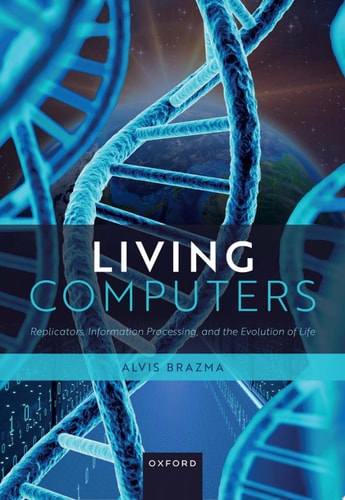
Living Computers: Replicators, Information Processing, and the Evolution of Life
0
0
As an Amazon Associate and affiliate partner, Menrva Books earns from qualifying purchases. Learn more
Author Description
This accessible and entertaining book explores the fundamental connections between life and information and how they emerged inextricably linked, taking the reader on a journey through all the major evolutionary transitions. It records the entire path of how life's information has evolved, starting from the growing polymers of prelife leading to the first replicators, through RNA and DNA to neural networks and animal brains, continuing through the major transition of human language and writing, into computer clouds, and finally heading towards an unknown future.All currently known life is based on three classes of molecules: proteins - life's main structural and functional building blocks; DNA - life's information molecule; and RNA - a molecule that provides the link between these two. Despite the existence of language and the new means of information recording and processing it enabled, at the current stage of life's evolution, the information stored in the natural repository of our planet's DNA archive remains indispensable. If the DNA on Earth were to become seriously corrupted, all cultural information and life itself would soon disappear. However, does future life have to be reliant on these molecules or could a living organism be made of e.g. steel, rubber, copper, and silicon? What was life like when it first emerged on Earth billions of years ago? What will life be like millions or billions of years from now, if it still exists? Could future civilisations, including the possible heirs of the present one, persist without proteins, DNA, and RNA? The author arms the reader with the knowledge required to speculate about such questions in an informed and reasoned way.Living Computers is aimed at students and scholars in a wide range of disciplines, from physics, computing, and biology to social sciences and philosophy. The fascinating idea of life as a computational phenomenon will also appeal to a more general readership interested in our origins and future exis
Menrva's Summary
THE THESIS
This book investigates the fundamental hypothesis that life is essentially a computational phenomenon, inextricably linked to the processing and storage of information. Prof. Alvis Brazma, an expert in bioinformatics and systems biology, synthesizes concepts from molecular biology, physics, and computer science to construct a framework for understanding life's evolution. He argues that the transition from biological molecules like DNA and RNA to synthetic substrates represents a continuous, logical progression in the history of information processing.
THE SCOPE MAP
What You Will Find
- A chronological analysis of major evolutionary transitions from prelife polymers to neural networks.
- An exploration of the role of language and writing as critical information-processing milestones.
- Theoretical models regarding the potential for non-biological life forms composed of silicon, steel, and copper.
Scope Limits
- The text does not provide a definitive prediction of future technological outcomes.
- It does not focus on the ethical implications of artificial intelligence or synthetic biology.
THE AUTHORITY PERSPECTIVE
Experts note that the book provides a bridge between biological theory and computational science for a broad audience. Readers frequently highlight the author's ability to simplify complex molecular processes while maintaining academic rigor.
Page Count:
320
Publication Date:
2024-01-01
Publisher:
Oxford University Press
ISBN-10:
0192871943
ISBN-13:
9780192871947
Science
Information Theory
Philosophy of
computing
Evolutionary Biology
Future Studies
Genetics
Community Tags
Similar Books