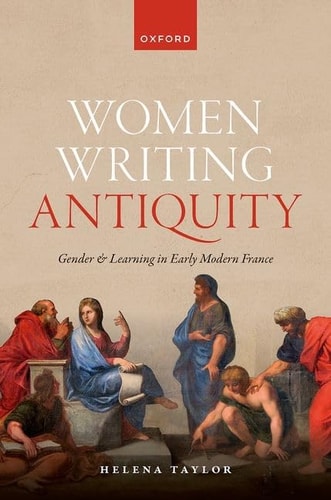
Women Writing Antiquity: Gender and Learning in Early Modern France
0
0
As an Amazon Associate and affiliate partner, Menrva Books earns from qualifying purchases. Learn more
Author Description
Women Writing Antiquity argues that the struggle to define the female intellectual in seventeenth-century France lay at the centre of a broader struggle over the definition of literature and literary knowledge during a time of significant cultural change. As the female intellectual became a figure of debate, France was also undergoing a shift away from the dominance of classical cultural models, the transition towards a standardized modern language, the development of a national literature and literary canon, and the emergence of the literary field. This book explores the intersection of these phenomena, analyzing how a range of women constructed the female intellectual through their reception of Greco-Roman culture.Women Writing Antiquity offers readings of known and less familiar works from a diverse corpus of translators, novelists, poets, linguists, playwrights, essayists, and fairy tale writers, including Marie de Gournay, Madeleine de Scudéry, Madame de Villedieu, Antoinette Deshoulières, Marie-Jeanne L'Héritier, and Anne Dacier. Challenging traditionally formalist and source-text orientated approaches, the study reframes classical reception in terms of authorial self-fashioning and professional strategy, and explores the symbolic value of Latin literacy to an author's projected identity. These writers used reception of Greco-Roman culture to negotiate the value attributed to different genres, the nature of poetics, the legitimacy of varied modes of authorship, the qualities and properties of French, and even how and by whom these topics might be debated. Women Writing Antiquity combines a new take on the literary history of the period with a retelling of the history of the figure of the 'learned woman'.
Menrva's Summary
THE THESIS
This book investigates how seventeenth-century French women utilized the reception of Greco-Roman antiquity to construct the identity of the female intellectual and influence the development of the national literary canon. Helena Taylor, a scholar of early modern French literature, examines how women writers navigated the cultural shifts of their era, including the transition toward a standardized language and the emergence of a professional literary field. By analyzing a diverse corpus of texts, the author argues that these women employed classical references as a strategic tool for self-fashioning and professional legitimacy.
THE SCOPE MAP
What You Will Find
- Analysis of works by Marie de Gournay, Madeleine de Scudéry, Madame de Villedieu, and Anne Dacier.
- Examination of the symbolic value of Latin literacy in seventeenth-century France.
- A framework reframing classical reception as a form of authorial self-fashioning.
Scope Limits
- The study focuses specifically on seventeenth-century France and does not extend to later periods of French literary history.
- It prioritizes authorial identity and professional strategy over traditional formalist or source-text analysis.
THE AUTHORITY PERSPECTIVE
Scholars frequently cite this work as a significant contribution to the study of gender and intellectual history in early modern Europe. Experts highlight the text for its ability to bridge the gap between classical reception studies and the history of women's writing in France.
Page Count:
304
Publication Date:
2024-01-01
Publisher:
Oxford University Press
ISBN-10:
0192870440
ISBN-13:
9780192870445
Politics
History
Early Modern
Womens Studies
Classical Reception
French literature
Literary Criticism
Community Tags
Other Editions(2)
Similar Books