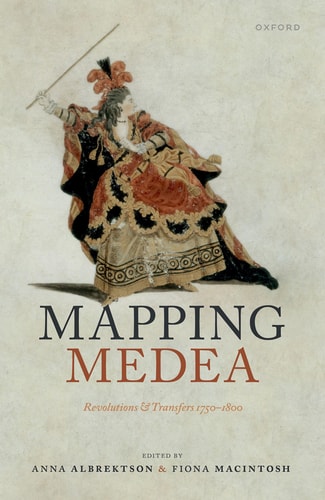
Mapping Medea: Revolutions and Transfers 1750-1800
0
0
As an Amazon Associate and affiliate partner, Menrva Books earns from qualifying purchases. Learn more
Author Description
The late-eighteenth century witnessed multiple Medeas take to the stages of Europe, in the Americas, and across the Russian empire. Performances took place in Moscow and São Paulo, in London and Lisbon, in Gotha, Stuttgart, and Venice. This lively collection of essays examines the various reasons why Medea, the ancient mother who killed her own children, attracted the attention of authors, audiences, actors, and rulers in Europe and its dominions during the pivotal period 1750 to 1800, and to what effects.As a migrant and iconoclast, Medea crosses a number of eighteenth-century borders: linguistic, cultural, national, temporal, spatial, aesthetic, ethical, and generic. Moreover, the fact that late-eighteenth-century playwrights, poets, composers, and choreographers all turned to one of the most problematic characters of Greco-Roman antiquity offers a unique opportunity to examine the remarkable flexibility of the reception process itself. Medea therefore functions as an intriguing case study, reflecting a wider context of cultural and political change within Europe and its colonies in the late-eighteenth century.By drawing together eighteenth-century specialists working across multiple languages and disciplines with the reception perspective of classical scholars, this volume brings much rare material from a range of archives across continental Europe to critical attention for the first time. Mapping Medea shows how the eighteenth century made Medea modern, and Medea helped to shape modern performance.
Menrva's Summary
THE THESIS
This volume investigates why the mythological figure of Medea became a central focal point for artistic and political expression across Europe and its colonies during the late eighteenth century. Editors Anna Albrektson and Fiona Macintosh, both established scholars in literature and classical reception, curate a collection of essays that analyze how playwrights, composers, and choreographers utilized this ancient archetype to navigate the cultural and political shifts of the period. By synthesizing archival research with interdisciplinary perspectives, the text argues that the eighteenth-century reception of Medea was instrumental in defining modern performance practices.
THE SCOPE MAP
What You Will Find
- Analysis of Medea performances in diverse locations including Moscow, São Paulo, London, and Venice.
- Examination of the character as a symbol of migration, iconoclasm, and ethical boundary-crossing.
- Interdisciplinary methodology combining classical scholarship with eighteenth-century literary and historical studies.
Scope Limits
- The analysis is strictly confined to the period between 1750 and 1800.
- The text focuses primarily on European and colonial theatrical reception rather than broader global mythological variations.
THE AUTHORITY PERSPECTIVE
Scholars and historians recognize this collection as a significant contribution to the field of classical reception studies due to its inclusion of rare, previously unexamined archival material. Readers frequently note the academic density of the prose, which serves as a specialized resource for researchers interested in the intersection of theater history and political change.
Page Count:
288
Publication Date:
2023-01-01
Publisher:
Oxford University Press
ISBN-10:
0192884190
ISBN-13:
9780192884190
History
18th century
Literary Criticism
Theater History
Theater
Community Tags
Similar Books