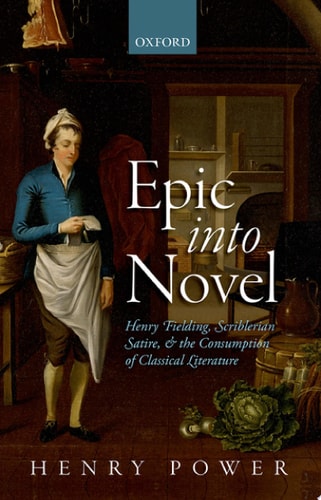
Epic into Novel: Henry Fielding, Scriblerian Satire, and the Consumption of Classical Literature
0
0
As an Amazon Associate and affiliate partner, Menrva Books earns from qualifying purchases. Learn more
Author Description
Epic into Novel looks at Henry Fielding's adaptation of classical epic in the context of what he called the 'Trade of... authoring'. Fielding was always keen to stress that his novels were modelled on classical literature. Equally, he was fascinated by--and wrote at length about--the fact that they were objects to be consumed. He recognised that he wrote in an age when an author had to consider himself 'as one who keeps a public Ordinary, at which all persons are welcome for their Money.' In describing his work, he alludes both to Homeric epic and to contemporary cookery books. This tension in Fielding's work has gone unexplored, a tension between his commitment to a classical tradition and his immersion in a print culture in which books were consumable commodities. This interest in the place of the ancients in a world of consumerism was inherited from the previous generation of satirists. The 'Scriblerians'--among them Jonathan Swift, John Gay, and Alexander Pope--repeatedly suggest in their work that classical values are at odds with modern tastes and appetites. Fielding, who had idolised these writers as a young man, developed many of their satiric routines in his own writing. But Fielding broke from Swift, Gay, and Pope in creating a version of epic designed to appeal to modern consumers. Henry Power provides new readings of works by Swift, Gay, and Pope, and of Fielding's major novels. He examines Fielding's engagement with various Scriblerian themes--primarily the consumption of literature, but also the professionalisation of scholarship, and the status of the author--and shows ultimately that Fielding broke with the Scriblerians in acknowledging and celebrating the influence of the marketplace on his work.
Menrva's Summary
THE THESIS
This book investigates the tension between Henry Fielding's commitment to classical epic traditions and his pragmatic immersion in the commercial realities of eighteenth-century print culture. Henry Power, a scholar of eighteenth-century literature, analyzes how Fielding navigated the transition from the high-minded ideals of the Scriblerian satirists to a model of authorship that embraced the marketplace. By examining Fielding's novels alongside the works of Swift, Gay, and Pope, Power argues that Fielding uniquely reconciled the status of the author as a professional tradesman with the aesthetic requirements of the epic form.
THE SCOPE MAP
What You Will Find
- Analysis of the Scriblerian satirists including Jonathan Swift, John Gay, and Alexander Pope.
- Examination of Henry Fielding's major novels in the context of classical adaptation.
- Discussion of the professionalization of scholarship and the status of the author in the eighteenth century.
- Exploration of the metaphor of the 'public Ordinary' and the consumption of literature.
Scope Limits
- The study focuses primarily on the eighteenth-century British context and does not extend to later developments in the novel form.
- The analysis does not provide a comprehensive biography of Fielding but focuses specifically on his engagement with classical tradition and consumerism.
THE AUTHORITY PERSPECTIVE
Scholars in the field of eighteenth-century studies recognize this work as a significant contribution to understanding the intersection of classical reception and the rise of the novel. Readers frequently note the academic density of the prose, which is intended for an audience familiar with both classical literature and the history of the book.
Page Count:
240
Publication Date:
2015-01-01
Publisher:
OUP Oxford
ISBN-10:
0191035823
ISBN-13:
9780191035821
Satire
History of the Novel
English & College Success
English
18th century
Literary Criticism
Book History
Community Tags
Similar Books