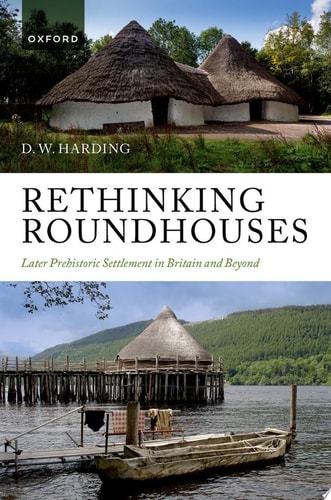
Rethinking Roundhouses: Later Prehistoric Settlement in Britain and Beyond
0
0
As an Amazon Associate and affiliate partner, Menrva Books earns from qualifying purchases. Learn more
Author Description
Excavated plans of roundhouses may compound multiple episodes of activity, design, construction, occupation, repair, and closure, reflecting successive stages of a building's biography. What does not survive archaeologically, through use of materials or methods that leave no tangible trace, may be as important for reconstruction as what does survive, and can only be inferred from context or comparative evidence. The great diversity in structural components suggests a greater diversity of superstructure than was implied by the classic Wessex roundhouses, including split-level roofs and penannular ridge roofs. Among the stone-built houses of the Atlantic north and west there likewise appears to have been a range of regional and chronological variants in the radial roundhouse series, and probably within the monumental Atlantic roundhouses too.Important though recognition of structural variants may be, morphological classification should not be allowed to override the social use of space for which the buildings were designed, whether their structural footprint was round or rectangular. Atlantic roundhouses reveal an important division between central space and peripheral space, and a similar division may be inferred for lowland timber roundhouses, where the surviving evidence is more ephemeral. Some larger houses were evidently byre-houses or barn houses, some with upper or mezzanine floor levels, in which livestock might be brought in or agricultural produce stored. Such 'great houses' doubtless served community needs beyond those of the resident extended family.The massively-increased scale of development-led excavations of recent years has resulted in an increased database that enables evaluation of individual sites in a wider landscape environment than was previously possible. Circumstances of recovery and recording in commercially-driven excavations, however, are not always compatible with research objectives, and the undoubted improvements in standards of environm
Menrva's Summary
THE THESIS
This work investigates how the archaeological interpretation of prehistoric roundhouses in Britain can be refined by moving beyond simple morphological classification to consider the social, functional, and structural complexities of these dwellings. D. W. Harding, a specialist in Iron Age archaeology, utilizes decades of excavation data to challenge traditional models of domestic space. He argues that the physical remains of roundhouses often obscure the dynamic life cycles of these buildings, necessitating a more nuanced approach that accounts for ephemeral evidence and regional variations.
THE SCOPE MAP
What You Will Find
- Analysis of structural variations including split-level and penannular ridge roofs.
- Comparative study of lowland timber roundhouses and Atlantic stone-built radial houses.
- Evaluation of the social use of space, including byre-house and mezzanine configurations.
- Assessment of the impact of modern development-led excavation data on landscape archaeology.
Scope Limits
- The text does not provide a comprehensive catalog of every known roundhouse site in Britain.
- It does not focus on the artistic or symbolic decoration of these structures, prioritizing functional and social utility instead.
THE AUTHORITY PERSPECTIVE
Experts recognize this text as a significant contribution to the study of later prehistoric settlement patterns, particularly for its critique of rigid typological classification. Readers frequently note the academic density of the prose, which is intended for professional archaeologists and advanced students of the field.
Page Count:
304
Publication Date:
2023-04-26
Publisher:
Oxford University Press
ISBN-10:
0192893807
ISBN-13:
9780192893802
Architecture
British History
Archaeology
Prehistoric Studies
Great Britain
Anthropology
Community Tags
Similar Books