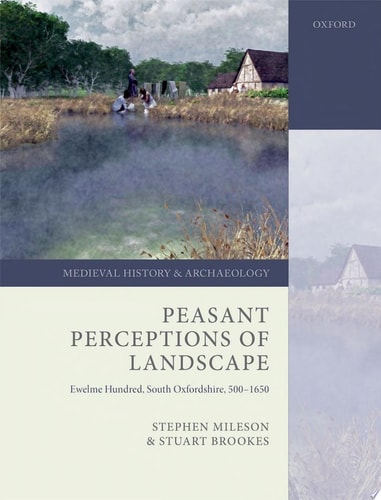
Peasant Perceptions of Landscape: Ewelme Hundred, South Oxfordshire, 500-1650
0
0
As an Amazon Associate and affiliate partner, Menrva Books earns from qualifying purchases. Learn more
Author Description
Peasant Perceptions of Landscape marks a change in the discipline of landscape history, as well as making a major contribution to the history of everyday life. Until now, there has been no sustained analysis of how ordinary medieval and early modern people experienced and perceived their material environment and constructed their identities in relation to the places where they lived. This volume provides exactly such an analysis by examining peasant perceptions in one geographical area over the long period from AD 500 to 1650.The study takes as its focus Ewelme hundred, a well-documented and archaeologically-rich area of lowland vale and hilly Chiltern wood-pasture comprising fourteen ancient parishes. The analysis draws on a range of sources including legal depositions and thousands of field-names and bynames preserved in largely unpublished deeds and manorial documents. Archaeology makes a major contribution, particularly for understanding the period before 900, but more generally in reconstructing the fabric of villages and the framework for inhabitants' spatial practices and experiences. In its focus on the way inhabitants interacted with the landscape in which they worked, prayed, and socialised, Peasant Perceptions of Landscape supplies a new history of the lives and attitudes of the bulk of the rural population who so seldom make their mark in traditional landscape analysis or documentary history.
Menrva's Summary
THE THESIS
This study investigates how ordinary rural inhabitants in Ewelme Hundred perceived, experienced, and constructed their identities within their material environment between 500 and 1650. Authors Stephen Mileson and Stuart Brookes, both established scholars in landscape history and archaeology, utilize a multi-disciplinary approach to bridge the gap between physical landscape evolution and the subjective experiences of the peasantry. By synthesizing documentary evidence with archaeological data, the authors argue that the rural population actively shaped their spatial practices and social identities in ways previously overlooked by traditional historiography.
THE SCOPE MAP
What You Will Find
- A longitudinal analysis of Ewelme Hundred, South Oxfordshire, spanning 1,150 years.
- Methodologies for interpreting field-names, bynames, and legal depositions as indicators of spatial perception.
- Archaeological reconstruction of village fabric and land-use patterns.
- Integration of manorial records and unpublished deeds to map social interaction.
Scope Limits
- The study is geographically confined to the specific parishes of Ewelme Hundred.
- The analysis focuses primarily on the peasant class, with less emphasis on the landed aristocracy or urban centers.
THE AUTHORITY PERSPECTIVE
Experts recognize this volume as a significant shift in landscape history, moving the focus from top-down administrative structures to the lived experience of the rural population. Scholars frequently note the academic density of the prose and the meticulous use of primary source material to reconstruct the medieval and early modern mindset.
Page Count:
384
Publication Date:
2022-02-04
Publisher:
Oxford University Press
ISBN-10:
0192894897
ISBN-13:
9780192894892
History
British History
Landscape History
Great Britain
Social History
Archaeology
Community Tags
Similar Books