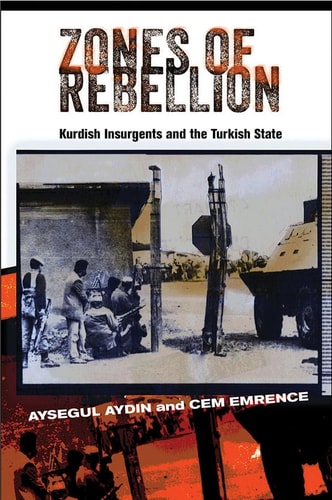
Zones of Rebellion: Kurdish Insurgents and the Turkish State
0
0
As an Amazon Associate and affiliate partner, Menrva Books earns from qualifying purchases. Learn more
Author Description
How do insurgents and governments select their targets? Which ideological discourses and organizational policies do they adopt to win civilian loyalties and control territory? Aysegul Aydin and Cem Emrence suggest that both insurgents and governments adopt a wide variety of coercive strategies in war environments. In Zones of Rebellion, they integrate Turkish-Ottoman history with social science theory to unveil the long-term policies that continue to inform the distribution of violence in Anatolia. The authors show the astonishing similarity in combatants’ practices over time and their resulting inability to consolidate Kurdish people and territory around their respective political agendas. The Kurdish insurgency in Turkey is one of the longest-running civil wars in the Middle East. Zones of Rebellion demonstrates for the first time how violence in this conflict has varied geographically. Identifying distinct zones of violence, Aydin and Emrence show why Kurds and Kurdish territories have followed different political trajectories, guaranteeing continued strife between Kurdish insurgents and the Turkish state in an area where armed groups organized along ethnic lines have battled the central state since Ottoman times. Aydin and Emrence present the first empirical analysis of Kurdish insurgency, relying on original data. These new datasets include information on the location, method, timing, target, and outcome of more than ten thousand insurgent attacks and counterinsurgent operations between 1984 and 2008. Another data set registers civilian unrest in Kurdish urban centers for the same period, including nearly eight hundred incidents ranging from passive resistance to active challenges to Turkey’s security forces. The authors argue that both state agents and insurgents are locked into particular tactics in their conduct of civil war and that the inability of combatants to switch from violence to civic politics leads to a long-running stalemate. Such
Menrva's Summary
THE THESIS
This book investigates the strategic choices made by both insurgents and states in conflict, focusing on the Kurdish-Turkish conflict. Aysegul Aydin and Cem Emrence analyze how these actors select targets, employ ideological discourses, and implement organizational policies to gain civilian support and control territory. By integrating Turkish-Ottoman history with social science theory, they reveal the persistent patterns of violence in Anatolia and the challenges faced by both sides in consolidating support. The work highlights the astonishing similarities in combatant practices over time, contributing to a prolonged stalemate.
THE SCOPE MAP
- Analysis of target selection strategies by insurgents and governments.
- Examination of ideological discourses and organizational policies for winning civilian loyalties.
- Integration of Turkish-Ottoman history with social science theory.
- Identification of distinct zones of violence and their impact on political trajectories.
- Empirical analysis of Kurdish insurgency using original data.
- Dataset detailing over ten thousand insurgent attacks and counterinsurgent operations (1984-2008).
- Dataset on civilian unrest in Kurdish urban centers (1984-2008).
- Argument that combatants are locked into specific tactics, leading to a long-running stalemate.
THE AUTHORITY PERSPECTIVE
The book is presented as a novel empirical analysis of the Kurdish insurgency, utilizing original datasets to examine the geographical variation of violence in the conflict. It aims to explain why different Kurdish territories have followed distinct political paths, ensuring ongoing strife. The authors' argument suggests that both state agents and insurgents are constrained by their chosen tactics, leading to a persistent stalemate rather than resolution. The work is positioned as a significant contribution to understanding one of the Middle East's longest-running civil wars.
Page Count:
192
Publication Date:
2015-04-09
Publisher:
Cornell University Press
ISBN-10:
0801453542
ISBN-13:
9780801453540
Politics
Non-Fiction
History
Sociology
Community Tags
Similar Books












Reader Comments
Share Your Thoughts
No comments yet. Be the first to share your thoughts!