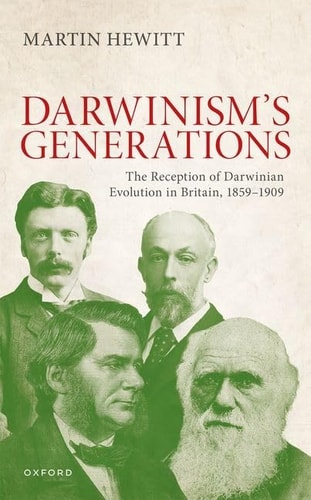
The Reception of Darwinian Evolution in Britain, 1859-1909: Darwinism's Generations
0
0
As an Amazon Associate and affiliate partner, Menrva Books earns from qualifying purchases. Learn more
Author Description
The Reception of Darwinian Evolution in Britain, 1859-1909: Darwinism's Generations uses the impact of Charles Darwin's On the Origin of Species (1859) in the 50 years after its publication to demonstrate the effectiveness of a generational framework for understanding the cultural and intellectual history of Britain in the nineteenth century. It challenges conventional notions of the 'Darwinian Revolution' by examining how people from across all sections of society actually responded to Darwin's writings. Drawing on the opinions and interventions of over 2,000 Victorians, drawn from an exceptionally wide range of archival and printed sources, it argues that the spread of Darwinian belief was slower, more complicated, more stratified by age, and ultimately shaped far more powerfully by divergent generational responses, than has previously been recognised. In doing so, it makes a number of important contributions. It offers by far the richest and most comprehensive account to date of how contemporaries came to terms with the intellectual and emotional shocks of evolutionary theory. It makes a compelling case for taking proper account of age as a fundamental historical dynamic, and for the powerful generational patternings of the effects that age produced. It demonstrates the extent to which the most common sub-periodisation of the Victorian period are best understood not merely as constituted by the exigencies of events, but are also formed by the shifting balance generational influence.Taken together these insights present a significant challenge to the ways historians currently approach the task of describing the nature and experience of historical change, and have fundamental implications for our current conceptions of the shape and pace of historical time.
Menrva's Summary
THE THESIS
This work investigates how the reception of Darwinian evolution in Britain between 1859 and 1909 was fundamentally shaped by generational dynamics rather than a singular, uniform intellectual revolution. Martin Hewitt, a historian specializing in nineteenth-century British culture, utilizes an extensive dataset of over 2,000 individual responses to challenge traditional historiography. He argues that the assimilation of evolutionary theory was a slow, stratified process influenced heavily by the age of the individuals encountering Darwin's ideas, thereby providing a new framework for understanding historical change.
THE SCOPE MAP
What You Will Find
- A comprehensive analysis of British intellectual and cultural responses to Darwinism from 1859 to 1909.
- A methodological framework for applying generational analysis to historical periods.
- Evidence derived from over 2,000 primary source interventions, including archival and printed materials.
Scope Limits
- The analysis is geographically restricted to Britain and does not cover the global reception of Darwinian theory.
- The study focuses on the cultural and intellectual reception rather than the technical scientific debates within the biological community.
THE AUTHORITY PERSPECTIVE
Scholars recognize this text as a significant contribution to Victorian studies for its rigorous use of archival data and its innovative application of generational theory. Experts frequently highlight the book's ability to complicate established narratives regarding the speed and uniformity of the Darwinian revolution.
Page Count:
576
Publication Date:
2024-12-12
Publisher:
Oxford University Press
ISBN-10:
0192890999
ISBN-13:
9780192890993
History
Cultural History
Intellectual History
Evolutionary Biology
Philosophy history
Science History
Community Tags
Similar Books