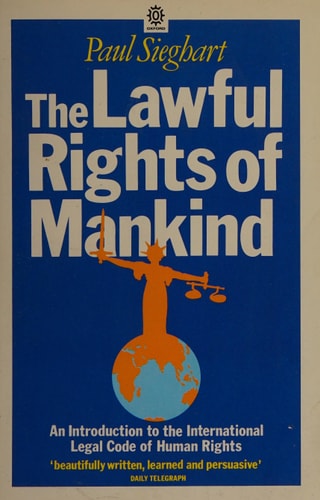
The Lawful Rights of Mankind: An Introduction to the International Legal Code of Human Rights
0
0
As an Amazon Associate and affiliate partner, Menrva Books earns from qualifying purchases. Learn more
Author Description
When we talk about human rights today, we are on much finer ground than if we were discussing the "moral" and "natural" rights of man which philosophers have debated for so long. Since 1945 a veritable legal revolution has prompted the installation of a complete, universally agreed code of human rights in international law. This book explains for the general reader what lies behind the code, how it was made, how it works, and what it says.
Menrva's Summary
THE THESIS
This book investigates the structure, origins, and practical application of the international legal code of human rights established following the events of 1945. Paul Sieghart, a noted expert in international law, utilizes a historical and analytical framework to transition the discourse on human rights from abstract moral philosophy to concrete legal reality. The text argues that a verifiable, universally agreed-upon legal architecture now exists to govern human rights, moving beyond the subjective debates of previous centuries.
THE SCOPE MAP
What You Will Find
- Historical context of the post-1945 international legal revolution
- Detailed explanation of the mechanisms behind the international human rights code
- Analysis of the specific provisions and legal language within the code
Scope Limits
- Does not provide an exhaustive case-by-case analysis of every international court ruling
- Does not focus on domestic constitutional law outside the scope of international treaties
THE AUTHORITY PERSPECTIVE
Experts recognize this work as a foundational introduction for those seeking to understand the transition of human rights into a formal legal discipline. Readers frequently note the clarity of the prose, which successfully translates complex legal frameworks into accessible information for the general public.
Page Count:
272
Publication Date:
1986-04-24
Publisher:
Oxford University Press
ISBN-10:
0192892088
ISBN-13:
9780192892089
History
Law
Human rights
International Law
Community Tags
Similar Books