The Rationalists
0
0
As an Amazon Associate and affiliate partner, Menrva Books earns from qualifying purchases. Learn more
Author Description
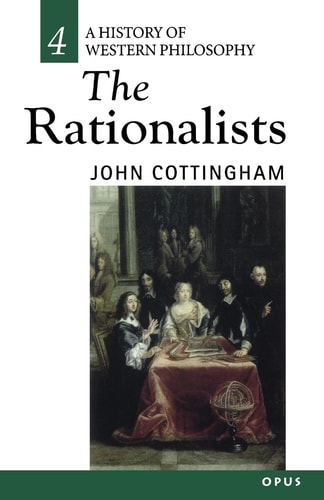
The seventeenth century saw a major revolution in our ways of thinking about such issues as the method appropriate to philosophy and science, the relation between mind and body, the nature of substance, and the place of humanity in nature. While not neglecting the lesser but still influential figures, such as Arnauld and Malebranche, John Cottingham focuses primarily on the three great "rationalists": Descartes, Spinoza, and Leibniz. He examines how they approached central problems of philosophy, and shows how closely their ideas are related, despite the radically different philosophical systems they produced. He not only places the major thinkers in their historical and philosophical contexts, but engages their ideas in a vigorously critical way, revealing their capacity to throw light on major philosophical topics that are still very much alive today.
Menrva's Summary
THE THESIS
This book investigates the core philosophical contributions of the seventeenth-century rationalist movement and how its central figures addressed the nature of mind, body, and human existence. John Cottingham, a noted scholar in the field of early modern philosophy, utilizes a comparative framework to analyze the works of Descartes, Spinoza, and Leibniz. By situating these thinkers within their historical context, he evaluates their distinct systems while identifying the shared logical problems that defined their era.
THE SCOPE MAP
What You Will Find
- Comparative analysis of Descartes, Spinoza, and Leibniz
- Examination of secondary figures including Arnauld and Malebranche
- Discussion of mind-body dualism and the nature of substance
- Historical contextualization of seventeenth-century scientific and philosophical methodology
Scope Limits
- Does not provide a comprehensive survey of all seventeenth-century thinkers
- Focuses primarily on rationalist traditions rather than empiricist counter-movements
THE AUTHORITY PERSPECTIVE
Experts frequently cite this work as a clear and rigorous introduction to the rationalist tradition for students and scholars alike. Readers often note the balance between historical detail and critical engagement with the primary philosophical arguments.
Page Count:
256
Publication Date:
1988-09-22
Publisher:
Oxford University Press
ISBN-10:
0192891901
ISBN-13:
9780192891907
Non-Fiction
Philosophy
Rationalism
Philosophy history
17th Century