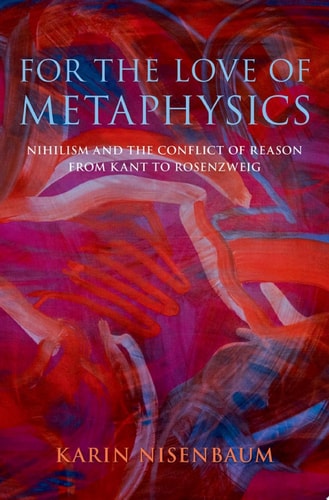
For the Love of Metaphysics: Nihilism and the Conflict of Reason from Kant to Rosenzweig
0
0
As an Amazon Associate and affiliate partner, Menrva Books earns from qualifying purchases. Learn more
Author Description
In his Critique of Pure Reason, Kant argued that human reason is inherently conflicted, because it demands a form of unconditioned knowledge which is unattainable; his solution to this conflict of reason relies on the idea that reason's quest for the unconditioned can only be realized practically. Karin Nisenbaum recommends viewing this conflict of reason, and Kant's solution to this conflict, as the central problem shaping the contours of post-Kantian German Idealism. She contends that the rise and fall of German Idealism is to be told as a story about the different interpretations, appropriations, and radicalization of Kant's prioritizing of the practical. The first part of the book explains why Kant's critics and followers came to understand the aim of Kant's critical philosophy in light of the conflict of reason. According to Nisenbaum, F. H. Jacobi and Salomon Maimon set the stage for the reception of Kant's critical philosophy by conceiving its aim in terms of meeting reason's demand for unconditioned knowledge, and by understanding the conflict of reason as a conflict between thinking and acting, or knowing and willing. The manner in which the post-Kantian German Idealists radicalized Kant's prioritizing of the practical is the central topic of the second part of the book, which focuses on works by J.G. Fichte and F.W.J. Schelling. The third part clarifies why, in order to solve the conflict of reason, Schelling and Rosenzweig developed the view that human experience is grounded in three irreducible elements--God, the natural world, and human beings--which relate in three temporal dimensions: Creation, Revelation, and Redemption.
Menrva's Summary
THE THESIS
This book investigates whether the conflict of reason, as articulated by Immanuel Kant, serves as the primary catalyst for the development and eventual trajectory of post-Kantian German Idealism. Karin Nisenbaum, a scholar of modern philosophy, examines how Kant's assertion that reason is inherently conflicted—demanding unconditioned knowledge that is only practically attainable—shaped the intellectual landscape of his successors. By analyzing the works of Fichte, Schelling, and Rosenzweig, Nisenbaum argues that the history of this philosophical movement is defined by varying attempts to resolve the tension between knowing and willing.
THE SCOPE MAP
What You Will Find
- An analysis of the conflict between theoretical knowledge and practical action in Kantian philosophy.
- A historical examination of the reception of Kant by F. H. Jacobi and Salomon Maimon.
- A detailed study of the radicalization of practical reason in the works of J.G. Fichte and F.W.J. Schelling.
- An exploration of the tripartite grounding of human experience in God, nature, and humanity as proposed by Schelling and Rosenzweig.
Scope Limits
- The text focuses specifically on the German Idealist tradition and does not provide a comprehensive survey of all post-Kantian European philosophy.
- The analysis is restricted to the specific problem of the conflict of reason and does not address every aspect of the philosophers' broader political or social theories.
THE AUTHORITY PERSPECTIVE
Scholars identify this work as a rigorous contribution to the study of German Idealism, noting its success in connecting Kantian foundations to the later developments of Rosenzweig. Readers frequently highlight the academic density of the prose, which is intended for those with a strong background in metaphysical inquiry.
Page Count:
294
Publication Date:
2018-01-01
Publisher:
Oxford University Press
ISBN-10:
0190680660
ISBN-13:
9780190680664
Philosophy
Metaphysics
Kant
nihilism
Rationalism
Reason
Philosophy history
Community Tags
Other Editions(2)
Similar Books