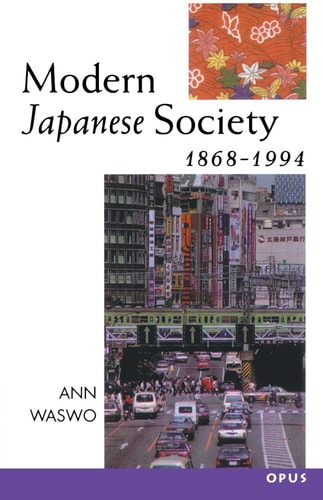
Modern Japanese Society, 1868-1994
0
0
As an Amazon Associate and affiliate partner, Menrva Books earns from qualifying purchases. Learn more
Author Description
The last 120 years have seen great social change and development in Japan. In the early 1870s Japan was still a third world country - a newly unified island nation with a highly agrarian economy and an insecure and weak government. By 1914 Japan has progressed towards the beginnings of an industrial economy, it had established a small empire for itself and the government had gained full and effective control over the entire country. Now, at the end of the twentieth century, Japan is an economic giant, with a massive export economy and considerable clout in the international world community.Ann Waswo outlines the role of the 'ordinary' Japanese citizen in this extraordinary history. One of the continuous themes in this history has been the steady relationship which the state has had with the people since the late nineteenth century, but this relationship has not been without change. Waswo focuses attention upon these developments, together with the many historical explanations for events in Japanese history - events which have too often been explained by the 'unique and enduring' quality of Japanese cultural traditions.
Menrva's Summary
THE THESIS
This work investigates how the social structure and daily lives of ordinary Japanese citizens evolved alongside the nation's rapid transformation from an agrarian society into a global economic power between 1868 and 1994. Ann Waswo, a scholar of Japanese history, utilizes a socio-historical framework to challenge traditional narratives that attribute Japan's development solely to unique cultural traits. By examining the shifting relationship between the state and its populace, the author provides a grounded analysis of how institutional changes impacted the lives of common people over more than a century.
THE SCOPE MAP
What You Will Find
- Analysis of Japan's transition from an agrarian economy to an industrial powerhouse.
- Examination of the evolving relationship between the Japanese state and its citizens.
- Historical context regarding the formation of the Japanese empire and its international influence.
- Critique of culturalist explanations for historical events.
Scope Limits
- The text focuses primarily on social and state-level developments rather than exhaustive military or diplomatic history.
- The analysis concludes in 1994, excluding subsequent economic and social shifts in the 21st century.
THE AUTHORITY PERSPECTIVE
Scholars and students of East Asian studies frequently cite this work as a balanced introduction to the social history of modern Japan. Readers often note that the prose is accessible while maintaining the academic rigor necessary for understanding complex historical developments.
Page Count:
192
Publication Date:
1996-05-23
Publisher:
Oxford University Press
ISBN-10:
0192892282
ISBN-13:
9780192892287
History
Sociology
Social change
Modern History
Japan
Japanese History
Community Tags
Similar Books