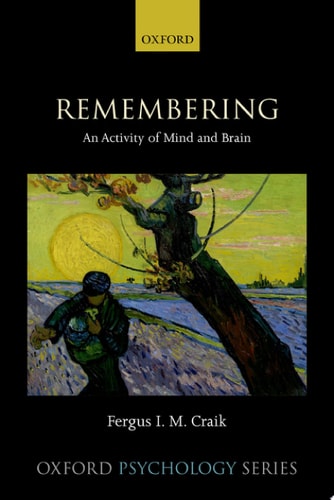
Remembering: An Activity of Mind and Brain
0
0
As an Amazon Associate and affiliate partner, Menrva Books earns from qualifying purchases. Learn more
Author Description
Memory is typically thought of as a set of neural representations - 'memory traces' - that must be found and reactivated in order to be experienced. It is often suggested that 'memory traces' are represented by a hierarchically organized system of analyzers, modified, sharpened and differentiated by encounters with successive events.Remembering: An Activity of Mind and Brain is the magnum opus of one of the leading figures in the psychology of memory. It sets out Fergus Craik's current view of human memory as a dynamic activity of mind and brain. The author argues that remembering should be understood as a system of active cognitive processes, similar to (perhaps identical to) the processes underlying attending, perceiving and thinking. Thus, encoding processes are essentially viewed as the mental activities involved in perceiving and understanding, and retrieval is described as the partial reactivation of these same processes. This account proposes that episodic and semantic memory should be thought of as levels in a continuum of specificity rather than as separate systems of memory.In addition, the book presents Craik's views on working memory and on age-related memory impairments. In the latter case the losses are attributed largely to a difficulty with the self-initiation of appropriate encoding and retrieval operations compensated, when needed, by support from the external environment. The development of these ideas is discussed throughout the book and illustrated substantially by experiments from the author's lab, but also by empirical and theoretical contributions from other researchers.A broad account of current ideas and findings in contemporary memory research, but viewed from the author's personal theoretical standpoint, Remembering: An Activity of Mind and Brain will be essential for researchers, graduate and postdoctoral students working in the field of human memory.
Menrva's Summary
THE THESIS
This book investigates the core question of whether memory should be conceptualized as a static storage of neural representations or as a dynamic, active cognitive process. Fergus I. M. Craik, a prominent researcher in memory psychology, synthesizes decades of empirical research to argue that remembering is fundamentally linked to the processes of attending, perceiving, and thinking. He proposes a theoretical framework where episodic and semantic memory exist on a continuum of specificity rather than as distinct, separate systems.
THE SCOPE MAP
What You Will Find
- Theoretical framework for memory as an active cognitive process
- Analysis of working memory and age-related memory impairments
- Integration of experimental data from the author's laboratory
- Synthesis of contemporary empirical and theoretical contributions from the field
Scope Limits
- The text focuses primarily on the author's personal theoretical standpoint rather than an exhaustive survey of all competing memory models
- It does not cover clinical pathology of memory disorders beyond age-related decline
THE AUTHORITY PERSPECTIVE
Experts recognize this work as a significant synthesis of the author's long-standing contributions to cognitive psychology. Readers frequently note the academic density of the prose, making it most suitable for graduate students and researchers in the field of human memory.
Page Count:
320
Publication Date:
2021-08-10
Publisher:
Oxford University Press
ISBN-10:
0192895222
ISBN-13:
9780192895226
Psychology
Memory
Neuroscience
Academic
Community Tags
Other Editions(3)
Similar Books



Reader Comments
Share Your Thoughts
No comments yet. Be the first to share your thoughts!