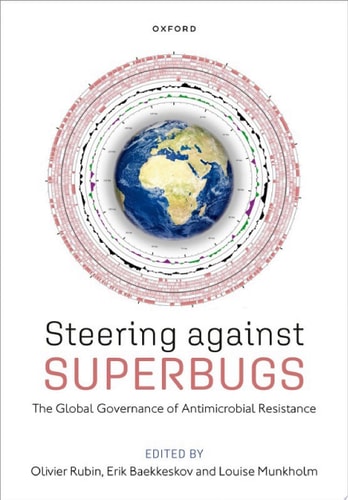
Steering Against Superbugs: The Global Governance of Antimicrobial Resistance
0
0
As an Amazon Associate and affiliate partner, Menrva Books earns from qualifying purchases. Learn more
Author Description
The societal consequences of antimicrobial resistance (AMR) are severe. They include declining health outcomes from longer illnesses, prolonged stays in hospital, loss of protection for patients undergoing medical procedures, increased health care expenditure, and increased mortality. They also include declining global food security as AMR damages farm animal health and crop yields. Despite AMR being a transboundary crisis, concerted global initiatives that effectively combat AMR have been few and far between. Steering Against Superbugs analyses ways to reduce barriers and create opportunities for coordination. The expert contributions in this volume offer specific and original insights about what global governance of AMR means, and ways to help solve AMR issues. They show that effective governance relies crucially on pursuing local level implementation of key policies, and equitable recognition of solutions across multiple sectors within countries, and across the Global North and South. With the COVID-19 pandemic, societies across the world have been reminded of the devastating consequences of not being able to effectively counter global health threats. AMR is arguably one of the most severe long-term threats to human, animal, and environmental health. There is momentum for global political action around novel and emerging disease threats and Steering Against Superbugs contributes with original and insightful research to inform ongoing and future debates.
Menrva's Summary
THE THESIS
This volume investigates the structural and political barriers preventing effective global governance of antimicrobial resistance (AMR) and proposes strategies for improved international coordination. The authors, Erik Baekkeskov, Louise Munkholm, and Olivier Rubin, curate a collection of expert contributions that examine the intersection of human, animal, and environmental health. By analyzing the failure of current international initiatives, the book argues that successful AMR mitigation requires localized implementation and equitable policy recognition across both the Global North and South.
THE SCOPE MAP
What You Will Find
- Analysis of the societal and economic consequences of AMR, including impacts on healthcare and food security.
- Frameworks for cross-sectoral coordination in global health policy.
- Comparative studies of policy implementation across different national contexts.
Scope Limits
- The text does not provide clinical medical protocols for treating specific resistant infections.
- It does not offer a comprehensive history of antibiotic development, focusing instead on governance and policy.
THE AUTHORITY PERSPECTIVE
Experts recognize this volume as a significant contribution to the study of global health security and institutional policy. Readers frequently note the academic density of the prose, which serves as a resource for policymakers and researchers interested in the political dimensions of infectious disease management.
Page Count:
299
Publication Date:
2023-01-01
Publisher:
OUP Oxford
ISBN-10:
019289949X
ISBN-13:
9780192899491
Medical
Public Health
Sociology
Medicine
Allied Health
Community Tags
Similar Books