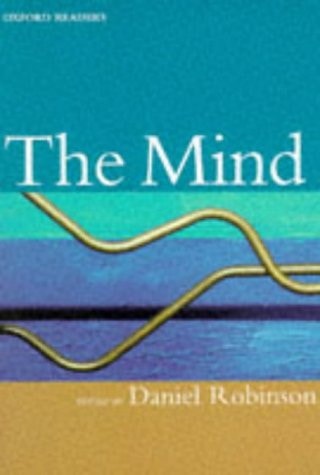
The Mind
0
0
As an Amazon Associate and affiliate partner, Menrva Books earns from qualifying purchases. Learn more
Author Description
At the beginning of the twenty-first century, it might seem that questions about the nature of the mind are best left to scientists rather than philosophers. How could the views of Aristotle or Descartes or Kant possibly contribute anything to debates about these issues, when the relevant neurophysiological facts and principles were completely unknown to them?This Oxford Reader shows that the arguments of philosophers throughout history still provide essential insights into contemporary questions about the mind and help to clarify the underlying scientific assumptions. Contributions from thinkers ranging from Plato and Locke to Roger Penrose and Oliver Sacks show that appreciating the full complexity of debates about consciousness, intelligence, and perception demands attention to fundamental questions that have occupied philosophers for over two thousand years.
Menrva's Summary
THE THESIS
This collection investigates whether historical philosophical inquiry remains relevant to modern scientific debates regarding the nature of the human mind. Daniel H. Robinson, a scholar of psychology and philosophy, compiles a diverse range of primary texts to argue that contemporary neuroscientific discourse is built upon foundational conceptual frameworks established by thinkers from antiquity to the present. By juxtaposing classical philosophy with modern scientific observation, the text demonstrates that empirical data alone cannot resolve fundamental questions about consciousness, intelligence, and perception.
THE SCOPE MAP
What You Will Find
- A chronological selection of philosophical and scientific writings spanning over two millennia.
- Comparative analysis between classical metaphysical arguments and modern neurophysiological findings.
- Perspectives from diverse thinkers including Plato, John Locke, Roger Penrose, and Oliver Sacks.
Scope Limits
- The text does not provide a comprehensive technical manual for neurobiological research methods.
- It does not attempt to offer a singular, unified theory of mind, but rather presents a spectrum of historical and contemporary viewpoints.
THE AUTHORITY PERSPECTIVE
Experts and academics frequently cite this volume as a valuable bridge between the humanities and the hard sciences for students and researchers alike. Readers often note that the prose is accessible yet intellectually rigorous, making it a standard reference for those seeking to understand the philosophical underpinnings of modern cognitive science.
Page Count:
400
Publication Date:
1998-12-03
Publisher:
Oxford University Press
ISBN-10:
0192893084
ISBN-13:
9780192893086
Psychology
Philosophy
Neuroscience
Mind & Body
Philosophy history
Community Tags
Similar Books