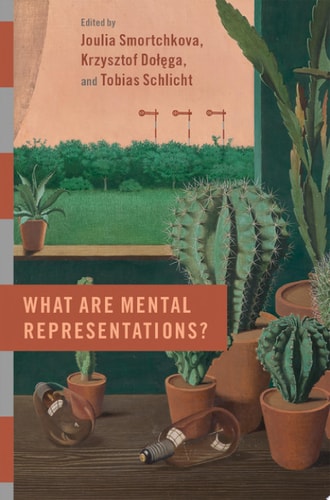
What Are Mental Representations?: Philosophy of Mind
0
0
As an Amazon Associate and affiliate partner, Menrva Books earns from qualifying purchases. Learn more
Author Description
The topic of this book is mental representation, a theoretical concept that lies at the core of cognitive science. Together with the idea that thinking is analogous to computational processing, this concept is responsible for the "cognitive turn" in the sciences of the mind and brain since the 1950s. Conceiving of cognitive processes (such as perception, reasoning, and motor control) as consisting of the manipulation of contentful vehicles that represent the world has led to tremendous empirical advancements in our explanations of behaviour. Perhaps the most famous discovery that explains behavior by appealing to the notion of mental representations was the discovery of 'place' cells that underlie spatial navigation and positioning, which earned researchers John O'Keefe, May-Britt Moser, and Edvard I. Moser a joint Nobel Prize in 2014. And yet, despite the empirical importance of the concept, there is no agreed definition or theoretical understanding of mental representation. This book constitutes a state-of-the-art overview on the topic of mental representation, assembling some of the leading experts in the field and allowing them to engage in meaningful exchanges over some of the most contentious questions. The collection gathers both proponents and critics of the notion, making room for debates dealing with the theoretical and ontological status of representations, the possibility of formulating a general account of mental representation which would fit our best explanatory practices, and the possibility of delivering such an account in fully naturalistic terms. Some contributors explore the relation between mutually incompatible notions of mental representation, stemming from the different disciplines composing the cognitive sciences (such as neuroscience, psychology, and computer science). Others question the ontological status and explanatory usefulness of the notion. And finally, some try to sketch a general theory of mental representations that could face th
Menrva's Summary
THE THESIS
This book investigates the fundamental theoretical and ontological status of mental representation, a concept central to cognitive science that currently lacks a unified definition.
The authors, Joulia Smortchkova, Krzysztof Dołrega, and Tobias Schlicht, curate a collection of essays from leading experts to address the lack of consensus regarding how mental states represent the world. By synthesizing perspectives from neuroscience, psychology, and computer science, the text examines whether a general, naturalistic account of representation is feasible given the current explanatory practices in the mind sciences. The contributors evaluate both the utility and the validity of the representational framework in explaining human and animal behavior.
THE SCOPE MAP
What You Will Find
- Theoretical debates on the ontological status of mental representations
- Comparative analysis of representational concepts across neuroscience, psychology, and computer science
- Critical evaluations of computational theories of mind
- Discussions on the possibility of a unified naturalistic theory of representation
Scope Limits
- Does not provide a single, definitive consensus definition of mental representation
- Focuses primarily on theoretical and philosophical inquiry rather than clinical application
THE AUTHORITY PERSPECTIVE
Experts and scholars in the philosophy of mind view this collection as a comprehensive survey of the current state of the field. Readers frequently note the academic density of the prose, making it a resource primarily intended for researchers and advanced students of cognitive science.
Page Count:
337
Publication Date:
2020-01-01
Publisher:
Oxford University Press
ISBN-10:
0190686693
ISBN-13:
9780190686697
Philosophy
Psychology
Neuroscience
Philosophy of
Mind & Body
Community Tags
Similar Books







Reader Comments
Share Your Thoughts
No comments yet. Be the first to share your thoughts!