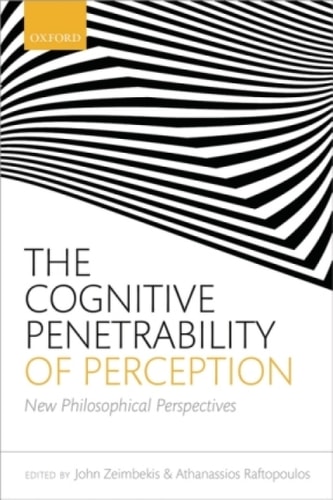
The Cognitive Penetrability of Perception: New Philosophical Perspectives
0
0
As an Amazon Associate and affiliate partner, Menrva Books earns from qualifying purchases. Learn more
Author Description
According to the cognitive penetrability hypothesis, our beliefs, desires, and possibly our emotions literally affect how we see the world. This book elucidates the nature of the cognitive penetrability and impenetrability hypotheses, assesses their plausibility, and explores their philosophical consequences. It connects the topic's multiple strands (the psychological findings, computationalist background, epistemological consequences of cognitive architecture, and recent philosophical developments) at a time when the outcome of many philosophical debates depends on knowing whether and how cognitive states can influence perception. All sixteen chapters were written especially for the book. The first chapters provide methodological and conceptual clarification of the topic and give an account of the relations between penetrability, encapsulation, modularity, and cross-modal interactions in perception. Assessments of psychological and neuroscientific evidence for cognitive penetration are given by several chapters. Most of the contributions analyse the impact of cognitive penetrability and impenetrability on specific philosophical topics: high-level perceptual contents, the epistemological consequences of penetration, nonconceptual content, the phenomenology of late perception, metacognitive feelings, and action. The book includes a comprehensive introduction which explains the history of the debate, its key technical concepts (informational encapsulation, early and late vision, the perception-cognition distinction, hard-wired perceptual processing, perceptual learning, theory-ladenness), and the debate's relevance to current topics in the philosophy of mind and perception, epistemology, and philosophy of psychology.
Menrva's Summary
THE THESIS
This volume investigates the cognitive penetrability hypothesis, which posits that internal mental states such as beliefs and desires influence the fundamental nature of human perception. Editors Athanassios Raftopoulos and John Zeimbekis compile sixteen original essays that synthesize psychological data, computational theory, and neuroscientific evidence to evaluate whether perceptual processes remain encapsulated from higher-level cognitive functions. The text provides a rigorous framework for understanding how the interaction between cognition and perception shapes our epistemological access to the world.
THE SCOPE MAP
What You Will Find
- Conceptual analysis of modularity, informational encapsulation, and perceptual learning.
- Assessments of neuroscientific and psychological evidence regarding late versus early vision.
- Philosophical inquiries into high-level perceptual content, nonconceptual content, and metacognitive feelings.
- A comprehensive introduction detailing the historical development of the perception-cognition debate.
Scope Limits
- The text focuses primarily on philosophical and theoretical implications rather than providing a clinical manual for psychological practice.
- It assumes a baseline familiarity with contemporary analytic philosophy of mind and cognitive architecture.
THE AUTHORITY PERSPECTIVE
Experts identify this collection as a significant resource for scholars navigating the intersection of philosophy and cognitive science. Readers frequently note the academic density of the prose, which is tailored for advanced students and researchers in the field of mind and perception.
Page Count:
376
Publication Date:
2015-01-01
Publisher:
OUP Oxford
ISBN-10:
0191059161
ISBN-13:
9780191059162
Philosophy
Psychology
Mind & Body
Epistemology
Neuroscience
Philosophy of
Community Tags
Similar Books