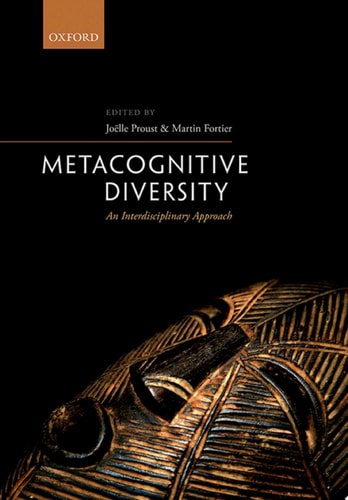
Metacognitive Diversity: An Interdisciplinary Approach
0
0
As an Amazon Associate and affiliate partner, Menrva Books earns from qualifying purchases. Learn more
Author Description
Metacognition refers to our awareness of our own mental processes, such as perceiving, remembering, learning, and problem solving. It is a fascinating area of research for psychologists, neuroscientists, anthropologists, sociologists and philosophers. This book explores the variability of metacognitive skills across cultures, since a person's decision to allocate effort, motivation to learn, sense of being right or wrong in perceptions, memories, and other cognitive tasks depends on specific transmitted goals, norms, and values. Across nineteen chapters, a group of leading authors analyze the variable and universal features associated with these dimensions, drawing on cutting-edge evidence. Additionally, new domains of metacognitive variability are considered in this volume, including those generated by metacognition-oriented embodied practices (present in rituals and religious worship), and culture-specific lay theories about subjective uncertainty and knowledge regarding natural or supernatural entities. It also documents universal metacognitive features, such as children's earlier sensitivity to their own ignorance than to that of others, people's intuitive understanding of what counts as knowledge, and speakers' sensitivity to informational sources (independently of the way the information is linguistically expressed). The book is important reading for students and scholars in cognitive and cultural psychology, anthopology, developmental and social psychology, linguistics, and philosophy.
Menrva's Summary
THE THESIS
This volume investigates how metacognitive processes—our awareness of mental functions like memory and learning—vary across different cultural contexts and social environments. Editors Joëlle Proust and Martin Fortier assemble a multidisciplinary team of experts to examine how transmitted goals, norms, and values shape individual cognitive regulation. By synthesizing evidence from psychology, anthropology, and philosophy, the authors argue that while certain metacognitive features are universal, many are deeply embedded in cultural practices and embodied rituals.
THE SCOPE MAP
What You Will Find
- Analysis of metacognitive variability in decision-making, motivation, and subjective certainty.
- Examination of embodied practices, including religious rituals and worship, as drivers of cognitive variability.
- Documentation of universal features such as early childhood sensitivity to personal ignorance.
- Cross-disciplinary perspectives from nineteen distinct chapters.
Scope Limits
- The text focuses primarily on theoretical and empirical research rather than providing practical self-help exercises for individual cognitive improvement.
- It does not cover clinical pathology or neurological disorders related to metacognitive impairment.
THE AUTHORITY PERSPECTIVE
Experts identify this collection as a significant interdisciplinary resource for scholars navigating the intersection of cognitive science and cultural anthropology. Readers frequently note the academic density of the prose, which serves as a rigorous reference for advanced students and researchers in the field.
Page Count:
456
Publication Date:
2018-01-01
Publisher:
OUP Oxford
ISBN-10:
0192506897
ISBN-13:
9780192506894
Philosophy
Psychology
Anthropology
Neuroscience
Cultural Anthropology
Mind & Body
Community Tags
Similar Books