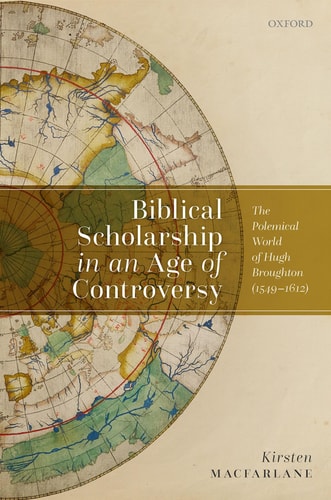
Biblical Scholarship in an Age of Controversy: The Polemical World of Hugh Broughton (1549-1612)
0
0
As an Amazon Associate and affiliate partner, Menrva Books earns from qualifying purchases. Learn more
Author Description
This book provides a new account of a distinctive, important, but forgotten moment in early modern religious and intellectual history. In the late sixteenth and early seventeenth centuries, Christian scholars were investing heavily in techniques for studying the Bible that would now be recognised as the foundations of modern biblical criticism. According to previous studies, this process of transformation was caused by academic elites whose work, whether religious or secular in its motivations, paved the way for the Bible to be seen as a human document rather than a divine message.At the time, however, such methods were not simply an academic concern, and they pointed in many directions other than that of secular modernity. Biblical Scholarship in an Age of Controversy establishes previously unknown religious and cultural contexts for the practice of biblical criticism in the early modern period, and reveals the diversity of its effects. The central figure in this story is the itinerant and bitterly divisive English scholar Hugh Broughton (1549-1612), whose prolific writings in Hebrew, Greek, Latin, and English offer a new and surprising image of Protestant intellectual culture. In this image, scholarly advances were not impeded but inspired by strict scripturalism; criticism was driven by missionary ideals, even as actual proselytization was sidelined; and learned neo-Latin texts were repackaged to appeal to ordinary believers. Seen through the eyes of Broughton and his neglected colleagues and followers, the complex and unexpected contributions of reformed Protestant intellectuals and laypeople to longer-term religious and cultural change finally become visible.
Menrva's Summary
THE THESIS
This book investigates how the development of early modern biblical criticism was shaped by intense religious controversy rather than a simple transition toward secular modernity. Kirsten Macfarlane, an expert in early modern religious history, utilizes the life and prolific writings of Hugh Broughton to challenge the traditional narrative that academic elites alone drove the shift toward viewing the Bible as a human document. By examining Broughton's work in Hebrew, Greek, Latin, and English, the author argues that scholarly advancements were often fueled by strict scripturalism and missionary zeal within Protestant intellectual circles.
THE SCOPE MAP
What You Will Find
- An analysis of the intellectual and cultural contexts of biblical criticism between 1549 and 1612.
- A detailed examination of Hugh Broughton's multilingual corpus and his influence on Protestant thought.
- Case studies on how neo-Latin scholarly texts were adapted for lay audiences.
Scope Limits
- The study focuses primarily on the English context and the specific intellectual network surrounding Broughton.
- It does not provide a comprehensive history of biblical criticism beyond the early seventeenth century.
THE AUTHORITY PERSPECTIVE
Scholars recognize this work as a significant contribution to the history of early modern intellectual culture, particularly for its nuanced portrayal of Protestant scholarship. Readers frequently note the depth of the archival research and the clarity with which the author navigates complex theological and linguistic debates.
Page Count:
288
Publication Date:
2022-02-11
Publisher:
Oxford University Press
ISBN-10:
0192898825
ISBN-13:
9780192898821
History
Religious History
Bible
Protestantism
History - Modern
Intellectual History
Community Tags
Similar Books